How Extra-Theater Operations Are Impacting the War in Ukraine

Swain Mathewson, University of Chicago
Introduction
The Russia–Ukraine war has long expanded beyond Eastern Europe. As the invasion approaches its fourth anniversary, both belligerents are increasingly leveraging peripheral theaters such as Africa and the Middle East, pursuing any advantage they can in what has devolved into a brutal war of attrition.
Moscow and Kyiv’s globalization of the war, also referred to as extra-theater conflict, has been present in nearly every form of indirect battlefield. Whether it be special forces engagements in the alleys of Khartoum, economic operations in the gold corridors of the Sahel, diplomatic maneuvering in the halls of West African embassies, or FPV drone teams fighting beside HTS in Syria, extra-theater conflict has redefined the fight in Europe [1][2][3].
Broadly, Russia has used these foreign arenas to leverage paramilitary forces, circumvent sanctions, and extract resources. Ukraine counters by seeking to isolate Moscow, deploying intelligence assets, special forces teams, and military advisors to starve Russia’s global revenue streams and render extra-theater operations abroad a zero-sum game.
Theoretical Framework: Proxy and Extra-Theater Warfare
The Russia–Ukraine war illustrates an advanced iteration of proxy conflict, where conventional and asymmetric instruments of war are used throughout transnational borders. Rather than simple delegation, these extra-theater operations represent a matryoshka of geopolitical agendas in which state and non-state actors pursue overlapping strategic incentives within diffuse zones of governance. Russia’s reliance on quasi-state paramilitaries such as the Wagner Group reflects a model of deniable power projection: fusing extractive capitalism, security outsourcing, and irregular warfare under the aegis of the state’s foreign policy apparatus. Ukraine’s emerging counter-model, while materially constrained, embodies a form of regionally distributed disruption, leveraging more asymmetrical methods such as intelligence operations, hastily formed localized partnerships, and inexpensive arms to degrade adversarial networks abroad.
The Strategic Role of Extra-Theater Operations
The impact of extra-theater operations is not just theoretical. The Russo-Ukrainian war’s globalization is quantifiable in the flow of gold, arms, and personnel. Illicit gold mining alone has generated billions for Wagner, and now the Africa Corps, since the 2022 invasion of Ukraine [4].
These revenues, filtered through shell companies throughout the Sahel and the other intermediaries, provided a significant cushion for Moscow’s sanctioned defense sector. Meanwhile, according to state-owned media, new multi-billion-dollar arms deals have been signed with several African countries, even as the West attempts to stifle Russian arms deals [5].
As a result, Ukraine’s extra-theater engagements directly target these revenue streams: degrading Wagner’s ability to extract, transport, and monetize African resources undermines a key parallel financing mechanism sustaining Russia’s war machine.
Sudan: Disrupting Russia’s Gold and Logistics Network
Sudan’s civil war is an acute case of a proxy contest with measurable economic consequences. A victory for the Russian-backed Rapid Support Forces (RSF) originally meant even greater gold concessions as well as assurance that the Russian naval base in Port Sudan, initially promised by the previous administration, would stay on track. On the other hand, a successful RSF ousting by the Ukraine-supported Sudanese Armed Forces (SAF) and their military government would have undermined a critical financial lifeline for Moscow’s war in Ukraine.
The cornerstone of Russia’s Sudanese revenue originates from Wagner’s Meroe Gold and Al-Sawlaj Gold Mining Company, which operated active mining concessions near al-Ibaidiya and Atbara in northeastern Sudan [6]. According to a whistleblower from inside the Sudanese Central Bank, a supposed 32.7 tons of gold were unaccounted for in 2021. Using the prices at the time of the report, this amounts to $1.9 billion worth of missing gold, at $60 million a ton [7].
Since the renewal of the Russian-Ukrainian war in 2022, Ukraine and the West have sought to attenuate all supranational revenue streams feeding Moscow’s war machine. Wagner’s Sudanese operations in particular have been distinctly inhibited via direct engagements with Ukrainian forces. Western sanctions have hindered the flow of gold, but the SAF, with the support of Ukrainian special operations, has constituted the Russian gold enterprises’ principal limiting factor [8].
A key example of this is Wagner shell company Al-Sawlaj Gold suspending its gold mining operations and evacuating Russian personnel working onsite in northern Sudan due to SAF control of the surrounding territory [6].
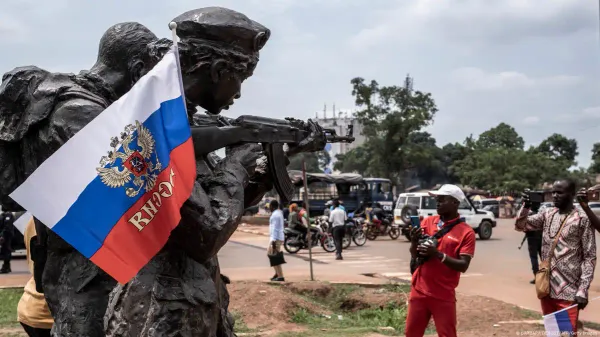
In the Darfur region, however, the seat of the RSF’s power, gold extraction and smuggling are still ongoing. Though Wagner has lost access to old smuggling routes such as Port Sudan, the paramilitary group has turned west, looking for a new Sahelian gold corridor. In decentralized neighboring Chad, the Russian government has conducted a successful influence campaign to wrestle the historically French-allied state into complicity with RSF operations in the region [9][10]. Furthermore, Chad is an ideal secondary route to smuggle Wagner’s illicit gold to their Middle-Africa client state, the Central African Republic, which has grown much closer to Russia in recent years [9].
Within the last year, the SAF, with covert Ukrainian assistance, regained control of several northern mining corridors [8][11]. As a result, Sudan’s contested goldfields shifted from being a financial reservoir for Russia to a liability demanding renewed protection and a change in strategy [6].
Notably, Moscow has attempted to pivot from strictly supporting the RSF to hedging their bets by rekindling relations with the SAF [12]. Though Russia was initially a crucial backer of the RSF, Russian deal-making with the SAF has been made possible by Russian diplomatic maneuvering amidst a backdrop of overlapping foreign support [13].
Sudan’s civil war is not as cut and dry as it may seem when it comes to foreign interests. Though the SAF has been supported by Ukraine and U.S. strategic partners such as Saudi Arabia and Egypt, it has also been supplied with crucial arms from Iran. Additionally, other U.S. strategic allies, such as the U.A.E., have funded the RSF [14]. Lastly, leaders of the RSF and SAF were both complicit in the Darfur Genocide, particularly the RSF’s Hemedti, and have both been sanctioned by the U.S. government [15][16].
With this in mind, Moscow never entirely severed diplomatic channels with the SAF’s military government, allowing Russia to easily rebalance its support to whichever side could credibly guarantee Russia a gold pipeline and a Red Sea naval base [13]. With the majority of the country now under SAF control, and the SAF being supported by Iran, Russia can hedge its play for a naval base while simultaneously withering bothersome SAF–Ukrainian cooperation [17].
Sudan, therefore, illustrates the mechanics of the Russo-Ukrainian extra-theater warfare at its most transactional. As Ukrainian-backed disruptions eroded Russia’s access to gold and logistics, Moscow adjusted by hedging rather than disengaging, prioritizing continued access to revenue streams and strategic infrastructure over loyalty to any single proxy. The result is not a clean proxy alignment, but a fluid contest in which influence accrues to whichever local actor can still deliver material leverage for the war in Ukraine.
Mali: The fight for Russia’s sanctionless market
In West Africa, the stakes are similarly measurable. Though Russia has a significantly growing presence in many West African countries, such as Niger and Burkina Faso, Russia’s footprint has been most pronounced in Mali. Consequently, Mali is also where Ukraine's counteractive extra-theater operations in West Africa are most aggressive.
In 2024, using current prices, Mali produced roughly $8.1 billion worth of gold, resources that Russia has sought to exploit via its paramilitary group, Wagner, and now, the Africa Corps [18]. Following the 2020-2021 coups, Bamako contracted Wagner to help fight Islamist insurgents after the government ousted French forces [19]. According to Wagner, they deployed over 2000 mercenaries to Mali by 2023 [20]. From 2021 to 2024, Mali’s government awarded Wagner security contracts worth over $10 million per month, financed directly through gold concessions [21]. In June 2025, the private force announced its withdrawal, saying it had “successfully completed” its mission. The Kremlin-controlled “Africa Corps” of ex-Wagner fighters now remains in Mali under official Russian military auspices [22].
Russia’s goal in Mali is clear: amidst sanctions of unprecedented scale, the Kremlin intends to tap into the country’s mineral wealth and channel it back to Moscow to further its war machine. In June 2025, a Russian-backed gold refinery began construction in Mali that is supposed to refine over 200 tons of gold per year, which is more than four times the country's annual gold production, explicitly intended to “give the country greater control over its natural resources,” [23]. Furthermore, without the need to ship gold to countries such as Switzerland, the UAE, and South Africa, Mali can use its new excessive in-country plant to provide gold refinement to neighboring allied juntas such as the similarly Russian-backed Burkina Faso and Niger [23]. This refinery will give Niger, Burkina Faso, Mali, and most notably, Russia an almost uncontested supply of West African gold.
Today, these African gold flows are closely linked to Russia’s war effort. A former advisor to Ukraine’s Ministry of Defense stated that the core axiom of Moscow’s West African strategy has been one of “plundering the resources of African countries for its own enrichment” by backing military regimes in exchange for resource access [24]. This pattern of extractivist security arrangements has become much more numerous and aggressive since the start of the renewal of the war in Ukraine, particularly with its ensuing economic limitations.
Ukraine’s own intelligence leadership explicitly stated that Africa’s “blood gold” is helping finance Russia’s invasion. Thus, to curtail Mali’s gold exports, Kyiv has focused on limiting Russia’s ability to extract gold and other resources to cripple that revenue stream.
To disrupt Russia’s off-budget war financing, Ukraine has expanded its operations into northern Mali by covertly supporting the Tuareg-led Cadre Stratégique Permanent insurgency (CSP), or Permanent Strategic Framework insurgency in English. After the rebels suffered major defeats at the hands of the Russian-backed government in 2023, Kyiv escalated its cooperation with the rebel group in early 2024. Ukrainian military intelligence (GUR) trained CSP fighters in drone warfare both in Ukraine and later on Malian soil, focusing on tactics involving small kamikaze drones [25]. These drones were first deployed during the July 2024 ambush at Tin Zaouatine, in northern Mali, where CSP fighters killed over 80 Wagner mercenaries in what remains Russia’s worst defeat in Africa [25]. Though not officially acknowledged at the time, Ukraine’s role was widely inferred after GUR spokesman Andriy Yusov stated on a local radio broadcast that CSP had “received the necessary information… to carry out a successful military operation against Russian war criminals,” prompting Mali’s government to cut diplomatic ties with Kyiv [26].
Since then, Ukrainian-backed drone strikes have continued against Wagner and Africa Corps outposts in Goundam and Léré, aiming to disrupt gold transport and logistics [25]. These covert actions fit well into Ukraine’s broader extra-theater strategy: leveraging low-cost partnerships to degrade Russia’s ability to extract and monetize foreign resources that fund the war in Ukraine. By turning peripheral insurgents into capability amplifiers in Ukraine’s asymmetric war, Ukraine forces Moscow to divert manpower and capital away from the main battlefield. As with similar operations in Sudan and Syria, the campaign in Mali targets the logistical and financial infrastructure sustaining Russian combat power, in turn, reducing Moscow’s capacity to fund mercenaries, procure arms, and maintain battlefield momentum in Ukraine.
Syria: Russia’s Mediterranean Foothold Left Vulnerable Following Ukrainian Pressure
Russia’s intervention in Syria since 2015 was designed to secure Assad’s regime and establish permanent bases beyond Russia’s borders. The Khmeimim air base and expanded Tartus naval facility give Moscow its only direct foothold in the Eastern Mediterranean, and crucially, as a staging post to transport paramilitaries and material support to Africa [27][28] In realist terms these outposts serve multiple strategic ends: they anchor Russia’s Black Sea fleet into the Middle East, enable power projection into North Africa, and help deter or channel regional rivals. Beyond convenient geographic positioning, Syria has also provided concrete military and economic benefits to Russia. Observers note that Russia’s campaign in Syria cemented its great power credentials and gave it tangible leverage in the region [29]. The Eastern Mediterranean platform allowed Moscow to establish logistics lines to Africa and to play mediator with Iran and Turkey, and crucially enabled it to block proposed Persian-Gulf–to–Europe gas pipelines that would undermine Russia’s energy dominance [29]. Syria likewise became a proving ground for Russian arms, as from 2015–19 Russia tested hundreds of new weapons there and saw its global arms sales surge to over $6 billion per year [30][31]. These gains, from weapon sales to strategic pipelines, helped bankroll Russia’s war effort. In effect, what Moscow wins in influence, financing, and positioning in Syria has fed directly back into the Ukraine fight, even with the toppling of Assad.
In line with the rest of Kyiv’s extra-theater strategy, Ukraine has leveraged covert action in an attempt to quietly open a new Syrian front against Russia. According to the Washington Post’s report, Ukrainian intelligence covertly shipped roughly 150 FPV attack drones and about 20 trained operators to Syria’s Islamist opposition group, HTS, just ahead of their December 2024 offensive that successfully took Assad out of power [32]. Ukraine’s government denied these allegations, but the report fits both Kyiv’s broader strategy of undermining Russian proxies abroad and the drone-based operations the GUR regularly employs [33]. Ukrainian special forces have also surfaced in open-source footage fighting alongside Syrian rebels against Russian-backed units. A Ukrainian military source even told reporters that its operatives have assisted insurgents in carrying out “numerous” strikes on Russian facilities in Syria [28]. Moscow, for its part, has accused Ukraine of arming “terrorists” in northwestern Syria and warned that Ukraine’s meddling could threaten Russia’s Syrian bases [28]. However, clandestine campaigns have had limited success in sapping Russian strength in the region. Satellite imagery shows Russian naval assets had left the Tartus naval base, but Russian aircraft had remained in Khmeimim airbase [28].
That said, by supporting the rebel-led collapse of Assad’s regime in Syria, Ukraine has forced Russia to reconsider the security of its Middle East assets instead of fully concentrating on the Ukraine front. Furthermore, analysts note that Russia has already redeployed many Syrian-based units into the Ukraine war, leaving its Tartus and Khmeimim garrisons relatively under-manned and more vulnerable [34]. In other words, Ukraine’s Syria gambit, like its African operations, is intended to tie down and sever Russia’s military and financial resources by capitalizing on spread-thin Russian forces abroad.
Syria is therefore another model example of the mechanics of Russia and Ukraine’s extra-theater competition, where Ukrainian clandestine efforts to erode Russian influence compel Moscow to sustain costly peripheral commitments that constrain its capacity to prosecute the war in Ukraine.
Shadow Fleet Strikes: Ukraine Takes Extra-Theater Warfare to Sea
Having brought the war into the gold corridors of Africa and the rebel-held enclaves of Syria, Ukraine has now pushed its extra-theater operations offshore, targeting the maritime networks that keep Russia’s war economy afloat.
By attacking the ships that make up Russia’s ‘shadow fleet,’ Ukraine disrupts the network of aging tankers that evade sanctions to carry Kremlin-controlled oil to world markets. Maritime analysts emphasize that the shadow fleet consists of hundreds of vessels using opaque ownership and flags of convenience to keep Russian oil flowing despite Western sanctions [35]. In December of 2025, Kyiv’s security service (SBU) reported using long-range aerial drones to hit the Oman-flagged tanker Qendil off of Libya’s coast, the first publicly confirmed time a shadow-fleet vessel was struck outside the Black Sea [36]. Earlier that fall, Ukrainian naval “Sea baby” underwater drones struck two Russian tankers, Kairos and Virat, off the Turkish coast. Both were empty and headed to Russia’s Novorossiysk terminal to load oil [37]. By targeting these sanctioned vessels, Ukraine aims to choke off the revenue from Russia’s oil exports that keep the Kremlin’s war economy afloat. As one SBU source noted, these tankers “were used to circumvent sanctions and earn money” for the war, making them, legally, an “absolutely legitimate target,” [35]. A Russian-linked tanker carrying 39000 tons of diesel oil was hit by unknown ‘external explosions’ as far as the Senegalese coast [38]. The authorities have not ruled out a Ukrainian attack as much of the evidence points to the same drone-based attacks Ukraine has used previously [39]. That said, a Ukrainian attack in the Atlantic would be unprecedented.
This campaign represents a clear expansion of Ukraine’s strike range into global logistics. In recent weeks, Kyiv’s forces have also hit offshore oil installations and patrol ships in the Caspian Sea [40]. Both operations were a part of a broader effort to degrade Russia’s oil infrastructure, and more importantly, to diminish foreign confidence in Russian oil. Even if Ukrainian drone attacks only damage oil tankers enough to cause minor delays, the economic implications for the recipient states is still significant. By taking the war to these ships on multiple seas, Kyiv forces Moscow to guard long supply lines and forces Russian oil revenues, a key war-funding source, to dwindle.
The Strategic and Economic Implications of the Extra-Theater War
The strategic and economic implications of Russia and Ukraine’s extra-theater war for the course of the main front cannot be understated enough. In every conceivable axis of conflict, in munitions and arms procured, in manpower deployed, and in lives lost, the international conflict being held beyond the bounds of Eastern Europe is pivotal.
According to a World Gold Council report authored by former UK Deputy Prime Minister Dominic Raab, the Kremlin-linked Wagner Group and, more recently, Africa Corps generated over $2.5 billion from the illicit gold trade during the first two years since the conflict renewed [4]. These funds have been used to help bankroll Russia’s invasion of Ukraine. It should also be noted that this data does not include Africa Corps’ illicit gold earnings from the last year, or any other form of earnings since the start of the invasion.
Though the Africa Corps’ key 2022-2024 earnings are a valuable data point on their own, their translation to battlefield procurement is substantial due to the efficient war economy Russia has developed since 2022. Russia’s most cost-effective weapon, as a ratio of cost per target struck, the Shahed-136/131 kamikaze drone, costs an estimated $35,000 and has a 10% target hit rate [41]. Russia produces an estimated 60,000 Shahed-type drones per year [42]. Using the baseline $2.5 billion for funds generated by Wagner/Africa Corps via illicit gold from 2022-2024, Russia could, excluding infrastructural barriers, produce an additional 71,428 drones. This would more than double yearly production. Additionally, based on Shahed strike success rates, this would mean an average of 7,142 additional targets struck. Such a heightened battlefield capability could have a major effect on the tide of battle within various oblasts.
It is important to note that, though this value is quite theoretical, it uses almost strictly conservative estimates for drone cost and revenue generated from illicit gold. The funds generated from all other Africa Corps activities, as well as indirectly earned through cash contracts and trade abroad, enabled by operations around the globe, would be even greater.
A more concrete example of extra-theater funds to battlefield procurement would resemble a cheaper renegotiated version of the 2022 contract between Russia and Iran. The contract was established for Russia to purchase Shahed drones from their original producer, Iran. The contract outlined an exchange of technology, equipment, 6000 Shahed drones, and software at $1.75 billion, according to a leak from the Iranian manufacturers of the Shahed drone [43]. Though this price-per-unit is nearly ten times greater than the Russian locally produced estimated cost, this is to be expected from the more technologically advanced Iranian originals produced without a war economy-of-scale. Furthermore, recently captured Shahed drones exhibit technology-stripped and bare-boned insides, cutting out nearly all non-essential technology [41].
If the estimated over $2.5 billion in illicit gold revenues extracted by Wagner and affiliated entities had not been allocated toward Shahed drone procurement, that sum could have been diverted to a range of high-impact military expenses. It would be enough to purchase approximately 555 T-90M main battle tanks [44], which is nearly five times the 67 that Russia had in active service prior to its 2022 invasion [45]. Alternatively, it could fund the production of around 2.5 million 152mm artillery shells [46], sufficient to sustain roughly 108 days of intensive shelling at Russia’s recent average fire rates [47]. The same amount could also cover six-month contracts for nearly 140,000 experienced Africa Corps mercenaries, based on 2022 compensation rates [48]. Finally, it could pay for nearly 10 percent of Russia’s total military personnel costs over a six-month period, which represents a substantial contribution given the scale of the country’s wartime mobilization [49]. These figures underscore the potential impact of extra-theater revenues in the Kremlin’s war economy and why Ukraine’s strategy of targeting those streams is central to undermining Russia’s capacity for sustained combat.
The potential battlefield capability enabled by Africa Corps’ illicit gold is substantial, but is only a portion of Africa Corps’ direct and indirect forms of earnings from extra-theater operations. Sanctionless trade to African states and beyond, via the Kremlin’s shadow fleet or other means, is enabled by Africa Corps’ bases and access to Tobruk’s port in eastern Libya [50]. This shadow-fleet trade represents Russia’s greatest foreign revenue stream, and 65% of Russia’s seaborne trade [51]. In total, the Kremlin’s shadow-fleet-based oil trade generates an estimated $87 to $100 billion in revenue per year, nearly 40 times greater than Africa Corps’ illicit gold revenue from 2022-2024 [51].
Finally, estimating what Russia could hypothetically purchase with illicit gold or shadow-fleet revenues assumes these funds are not already being used for procurement, when in reality, they are. Thus, revenue streams should be viewed primarily as vulnerabilities within Russia’s war financing regime. Vulnerabilities that can be targeted by Ukraine's extra-theater operations.
Greater successes by Ukraine-supplied rebels in Mali jeopardize Russia’s gold mining in the country as well as their security contracts. The new administration in Syria, which was aided militarily by Ukraine, has put Russia’s strategic holdings in the region at risk. Meanwhile, Ukrainian attacks on the shadow fleet and other oil infrastructure from the Caspian Sea to the Mediterranean diminish confidence in Russian oil and force the Kremlin to adopt more costly security measures.
Furthermore, the active threat to Russian revenue-generating assets in countries that Ukraine has already engaged in is significant, but there is a second tacit threat to all of Russia’s war financing channels abroad. Many other African countries that have partnered with the Africa Corps or act as economic pillars for Moscow may be targeted by Ukraine. As mentioned before, actors that are used to circumvent sanctions and fund the war are “absolutely a legitimate target,” according to the SBU [35]. All-out war with Moscow’s commercial footholds is not militarily or geopolitically feasible, but several Russian-backed, gold and oil-producing regimes remain strategically vulnerable. These include Burkina Faso, Niger, the Central African Republic, and Equatorial Guinea, all of which face ongoing threats from insurgency or piracy [52][53][54]. With targeted strategic support from Ukraine in the form of supplies, training, and intelligence, these existing instabilities could be exacerbated to threaten local Russian gold and oil assets.
Conclusion
What began as a conventional war along Europe’s eastern frontier has evolved into an intercontinental struggle over capital, logistics, and strategic endurance, stretching far beyond the confines of Eastern Europe. From Sudan’s goldfields to Mali’s insurgent enclaves, from Syrian airbases to the maritime networks sustaining sanctioned oil exports, extra-theater operations now play a direct role in sustaining or constraining combat operations in Ukraine. Russia has relied on extractive partnerships and opaque security arrangements to offset sanctions; Ukraine, facing conventional asymmetries, has instead targeted the revenue streams, transport routes, and resource-refining infrastructure that materially sustain Russia’s war effort. These cases reflect a greater shift in how modern wars are waged. Control over foreign resources and supply chains increasingly shapes battlefield capability as much as territorial gains. Ukrainian pressure has progressively turned regions once central to Russia’s sanction-evasion strategy from dependable sources of income into strategic liabilities. Nowhere is this clearer than in the Sahel, which has shifted from a relatively predictable source of revenue into a sustained theater of attrition, where insecurity, disrupted extraction, and rising protection costs steadily erode Moscow’s ability to convert overseas access into battlefield advantage.
Extra-theater operations are no longer auxiliary to the war in Ukraine but instead are constitutive of it. As long as modern military power depends on foreign flows of resources and revenue, many of the conflict’s decisive pressures will continue to be applied far from the front lines on which it is traditionally fought.
Notes
[1] Wall Street Journal, “Ukraine Is Now Fighting Russia in Sudan,” Wall Street Journal, August 2024, https://www.wsj.com/world/ukraine-is-now-fighting-russia-in-sudan-87caf1d8.
[2] Global Witness, “The Blood Gold Report 2023,” December 2023, https://bloodgoldreport.com/wp-content/uploads/2023/12/The-Blood-Gold-Report-2023-December.pdf.
[3] Washington Post Editorial Board, “Ukraine’s War With Russia Is Going Global,” Washington Post, December 10, 2024, https://www.washingtonpost.com/opinions/2024/12/10/ukraine-syria-russia-war/.
[4] World Gold Council, “Artisanal and Small-Scale Gold Mining,” World Gold Council, accessed 2024, https://www.gold.org/esg/artisanal-and-small-scale-gold-mining.
[5] Sputnik Africa, “Russia Signs New Arms Deals With African States,” Sputnik Africa, November 9, 2025, https://en.sputniknews.africa/20251109/1080328777.html.
[6] William Davison, “Wagner-Linked Gold Miner in Sudan Halts Operations Amid Fighting,” Bloomberg, September 19, 2023, https://www.bloomberg.com/news/articles/2023-09-19/wagner-linked-gold-miner-in-sudan-halts-operations-over-conflict.
[7] Nima Elbagir et al., “How Russia Cashes In on Sudan’s Gold,” CNN, July 29, 2022, https://edition.cnn.com/2022/07/29/africa/sudan-russia-gold-investigation-cmd-intl.
[8] Julian Borger, “Ukrainian Special Forces Target Russian Mercenaries in Sudan,” The Guardian, February 6, 2024, https://www.theguardian.com/world/2024/feb/06/ukrainian-special-forces-sudan-russian-mercenaries-wagner.
[9] BBC News, “How Russia Is Expanding Its Influence in Chad,” BBC News, December 2023, https://www.bbc.com/news/world-africa-67625139.
[10] Eric Schmitt, “Putin’s Gold Rush in Sudan,” New York Times, June 5, 2022, https://www.nytimes.com/2022/06/05/world/africa/wagner-russia-sudan-gold-putin.html.
[11] Al Jazeera, “Sudan’s Army Declares Khartoum State Free of RSF Forces,” Al Jazeera, May 20, 2025, https://www.aljazeera.com/news/2025/5/20/sudans-army-declares-khartoum-state-completely-free-of-paramilitary-rsf.
[12] Reuters, “Russia, Sudan Agree on Red Sea Naval Base,” Reuters, February 12, 2025, https://wwwreuters.com/world/russia-sudan-agree-red-sea-naval-base-sudanese-foreign-minister-says-2025-02-12/.
[13] Andrew S. Bowen, “Russia Switches Sides in Sudan’s War,” Jamestown Foundation, 2024, https://jamestown.org/russia-switches-sides-in-sudan-war/.
[14] Cameron Hudson, “Mapping the Conflict in Sudan,” Wilson Center, 2024, https://www.wilsoncenter.org/article/conflict-sudan-map-regional-and-international-actors.
[15] U.S. Department of State, “Genocide Determination in Sudan and Accountability Measures,” U.S. Department of State, 2024, https://2021-2025.state.gov/genocide-determination-in-sudan-and-imposing-accountability-measures/.
[16] United States Holocaust Memorial Museum, “Darfur,” USHMM Encyclopedia, accessed 2024, https://encyclopedia.ushmm.org/content/en/article/darfur.
[17] Anadolu Agency, “Territorial Control: Who Holds What in Sudan’s War,” Anadolu Agency, 2024, https://www.aa.com.tr/en/africa/territorial-control-who-holds-what-in-sudan-s-war/3734931.
[18] Reuters, “Mali Gold Production Plunges 23%,” February 8, 2025, https://www.reuters.com/markets/commodities/mali-gold-production-plunges-23-2024-2025-02-08/.
[19] Al Jazeera, “Wagner vs Africa Corps: The Future of Russian Paramilitaries in Mali,” June 16, 2025, https://www.aljazeera.com/news/2025/6/16/wagner-vs-africa-corps-the-future-of-russian-paramilitaries-in-mali.
[20] Royal United Services Institute, “A Mixed Picture: How Mali Views the Wagner Group,” RUSI, https://www.rusi.org/explore-our-research/publications/commentary/mixed-picture-how-mali-views-wagner-group.
[21] Global Witness, “The Blood Gold Report 2023,” December 2023, https://bloodgoldreport.com/wp-content/uploads/2023/12/The-Blood-Gold-Report-2023-December.pdf.
[22] BBC News, “What Is Russia’s Africa Corps and Where Is It Operating?” BBC News, https://www.bbc.com/news/articles/ce3ve0e7ndzo.
[23] Reuters, “Mali Starts Construction of Russia-Backed Gold Refinery,” June 17, 2025, https://www.reuters.com/world/africa/mali-starts-construction-russia-backed-gold-refinery-2025-06-17/.
[24] Lawfare, “How Ukraine Is Challenging Russia in Africa and the Middle East,” https://www.lawfaremedia.org/article/how-ukraine-is-challenging-russia-in-africa-and-the-middle-east.
[25] Le Monde, “Ukrainian Drones Provide Support for Northern Mali’s Rebels,” October 13, 2024, https://www.lemonde.fr/en/le-monde-africa/article/2024/10/13/ukrainian-drones-provide-support-for-northern-mali-s-rebels_6729231_124.html.
[26] The Guardian, “Ukraine Military Intelligence Claims Involvement in Deadly Wagner Ambush in Mali,” July 29, 2024, https://www.theguardian.com/world/article/2024/jul/29/ukraine-military-intelligence-claims-involvement-in-deadly-wagner-ambush-in-mali.
[27] Pjotr Sauer, “Moscow reaches out to new Syrian leadership in move to secure bases,” The Guardian, December 9, 2024, https://www.theguardian.com/world/2024/dec/09/moscow-reaches-out-to-new-syrian-leadership-in-move-to-secure-bases.
[28] Thibault Spirlet, “Ukraine supplied Syrian rebels with drones and operators for the offensive that toppled Assad last week: report,” Business Insider, December 11, 2024, https://www.businessinsider.com/ukraine-sent-drones-operators-syria-rebels-used-topple-assad-report-2024-12.
[29] Sergei Melkonian, “The Syria Fiasco As Seen From Moscow,” Carnegie Endowment for International Peace, December 24, 2024, https://carnegieendowment.org/middle-east/diwan/2024/12/the-syria-fiasco-as-seen-from-moscow?lang=en.
[30] Benoît Faucon and Stephen Kalin, “Russia’s War in Ukraine Hurts Its Arms Industry, Creates Openings for Rivals,” The Wall Street Journal, March 2022, https://www.wsj.com/articles/russias-war-in-ukraine-hurts-its-arms-industry-creates-openings-for-rivals-c25321c6.
[31] Luke Harding, “How Russia is using tactics from the Syrian playbook in Ukraine,” The Guardian, March 24, 2022, https://www.theguardian.com/world/2022/mar/24/how-russia-is-using-tactics-from-the-syrian-playbook-in-ukraine.
[32] David Ignatius, “Ukraine helped Syrian rebels deliver blow to Russia,” The Washington Post, December 10, 2024, https://www.washingtonpost.com/opinions/2024/12/10/ukraine-syria-russia-war/.
[33] Reuters, “Ukrainian operatives aided Syrian rebels with drones, Washington Post reports,” Reuters, December 11, 2024, https://www.reuters.com/world/ukrainian-operatives-aided-syrian-rebels-with-drones-washington-post-reports-2024-12-11/.
[34] Belfer Center for Science and International Affairs, “How do events in Syria affect Russia?” Belfer Center, accessed December 2025, https://www.belfercenter.org/research-analysis/how-do-events-syria-affect-russia.
[35] “Ukraine strikes Russian shadow fleet tanker in Mediterranean,” Euronews, December 19, 2025, https://www.euronews.com/2025/12/19/ukraine-strikes-russian-shadow-fleet-tanker-in-mediterranean.
[36] Reuters, “Ukraine hits Russian shadow fleet tanker in Mediterranean for first time, SBU source says,” Reuters, December 19, 2025, https://www.reuters.com/business/aerospace-defense/ukraine-hits-russian-shadow-fleet-tanker-mediterranean-first-time-sbu-source-2025-12-19/.
[37] Andrew Wilks, Suzan Fraser, and Isobel Koshiw, “Ukraine’s naval drones strike Russian oil tankers in the Black Sea off the Turkish coast,” Associated Press, November 29, 2025, https://apnews.com/article/tankers-russia-sanctions-shadow-fleet-mines-drones-black-sea-76dce005c40a0bf38faf2fbf8be71e38.
[38] Alex Longley, Firat Kozok, and Katarina Hoije, “Third Russia-Linked Oil Tanker Suffers Explosions at Sea,” Bloomberg, December 1, 2025, https://www.bloomberg.com/news/articles/2025-12-01/oil-tanker-mersin-suffered-explosions-off-senegal-manager-says.
[39] Abbas Asamaan, “Russian-linked oil tanker hit by ‘external explosions’ off coast of Senegal,” Le Monde, December 2, 2025, https://www.lemonde.fr/en/le-monde-africa/article/2025/12/02/russian-linked-oil-tanker-hit-by-external-explosions-off-the-coast-of-senegal_6748049_124.html.
[40] Reuters, “Ukraine says it hit Russian oil rig, patrol ship in Caspian Sea,” Reuters, December 20, 2025, https://www.reuters.com/business/energy/ukraine-says-it-hit-russian-oil-rig-patrol-ship-caspian-sea-2025-12-20/.
[41] Center for Strategic and International Studies, “Calculating the Cost-Effectiveness of Russia’s Drone Strikes,” CSIS, accessed December 2025, https://www.csis.org/analysis/calculating-cost-effectiveness-russias-drone-strikes.
[42] Institute for the Study of War, “Adversary Entente Cooperation at Russia’s Shahed Factory Threatens Global Security,” Institute for the Study of War, accessed December 2025, https://understandingwar.org/research/adversary-entente/adversary-entente-cooperation-at-russias-shahed-factory-threatens-global-security/.
[43] Tyler Rogoway, “What Does a Shahed-136 Really Cost?” The War Zone, February 6, 2024, https://www.twz.com/news-features/what-does-a-shahed-136-really-cost.
[44] “How Much Does Russia’s T-90M Tank Cost?” Kyiv Post, accessed December 2025, https://www.kyivpost.com/post/35708.
[45] International Institute for Strategic Studies, “Russian T-90M Production: Less Than Meets the Eye,” IISS, June 2024, https://www.iiss.org/online-analysis/military-balance/2024/06/russian-t-90m-production-less-than-meets-the-eye/.
[46] Deborah Haynes, “Russia is producing artillery shells around three times faster than Ukraine’s Western allies – and for about a quarter of the cost,” Sky News, June 2024, https://news.sky.com/story/russia-is-producing-artillery-shells-around-three-times-faster-than-ukraines-western-allies-and-for-about-a-quarter-of-the-cost-13143224.
[47] Illia Ponomarenko, “Ukraine’s deep strikes cut Russia’s ammunition use by half, military chief says,” The Kyiv Independent, July 2024, https://kyivindependent.com/ukraines-deep-strikes-cut-russias-ammunition-use-by-half-military-chief-says/.
[48] Al Jazeera, “Wagner private group now an extension of Russia’s military,” Al Jazeera, August 10, 2022, https://www.aljazeera.com/news/2022/8/10/wagner-private-group-now-an-extension-of-russias-military.
[49] Pyotr Kozlov, “Russian Military Personnel Costs Hit Record High, Analysis,” The Moscow Times, July 10, 2025, https://www.themoscowtimes.com/2025/07/10/russian-military-personnel-costs-hit-record-high-analysis-a89769.
[50] Paul Iddon, “Russia Uses ‘Ghost Fleet’ to Evade Sanctions, Traffic Weapons Across Africa,” ADF Magazine, April 2025, https://adf-magazine.com/2025/04/russia-uses-ghost-fleet-to-evade-sanctions-traffic-weapons-across-africa/.
[51] Center for Strategic and International Studies, “Ghost Busters: Options for Breaking Russia’s Shadow Fleet,” CSIS, accessed December 2025, https://www.csis.org/analysis/ghost-busters-options-breaking-russias-shadow-fleet.
[52] Council on Foreign Relations, “Violent Extremism in the Sahel,” Global Conflict Tracker, accessed December 2025, https://www.cfr.org/global-conflict-tracker/conflict/violent-extremism-sahel.
[53] Council on Foreign Relations, “Violence in the Central African Republic,” Global Conflict Tracker, accessed December 2025, https://www.cfr.org/global-conflict-tracker/conflict/violence-central-african-republic.
[54] Maisie Pigeon and Roxane E. Moss, “Atlantic piracy, current threats, and maritime governance in the Gulf of Guinea,” Atlantic Council, July 2025, https://www.atlanticcouncil.org/in-depth-research-reports/issue-brief/atlantic-piracy-current-threats-and-maritime-governance-in-the-gulf-of-guinea/.