Russian Drone Warfare: A Look at the Technology Behind Imperialist Aggression

Max Mottola, University of Chicago
Since September, drones have frequently appeared in the skies near military bases and airports in Poland, Germany, Denmark, and Norway. While some world leaders haven’t yet pointed the finger at Russia, German chancellor Friedrich Merz attributed a “significant portion” of the drones to Russian intelligence. Drone sightings in Poland have been accompanied by a coordinated disinformation campaign blaming Ukrainian and Polish intelligence, which experts attribute to bots and actors affiliated with Russian intelligence. Hundreds of thousands of posts shared on social platforms allege that the drones are Ukrainian. Social media accounts claim that Ukraine is feigning Russian aggression, a coercion tactic to secure more funding and resources from Poland. Another conspiracy theory circulating online suggests that Polish intelligence orchestrated the drone flights as a false flag operation to incentivize NATO’s further involvement in the Russian invasion of Ukraine.
Launching drones into European airspace works as a litmus test, exposing counter drone measures and gauging how the EU and NATO will respond. German and British officials have announced plans granting permission for police and military to shoot drones out of the skies. However, they have hit upon legal and bureaucratic obstacles. The German Constitution disallows the military from acting within German borders, except in emergency situations. Even if granted the authority, law enforcement lacks the training and resources to detect and take down unidentified drones.
Shooting down drones requires a complex yet efficient detection system and a thorough cost-benefit analysis assessing the risks involved. Expending missiles wastes precious national security arsenals. The Swedish Armed Forces has deployed a locally manufactured counterdrone system equipped with machine guns, which could be a less wasteful alternative. Downing drones also carries the risk of civilian casualties if debris lands within range of a public area. Drones are an emerging technology; many European intelligence and lawmaking bodies are simply not yet equipped to deal with the myriad drone strategies and types of drones in Russia’s arsenal.
Russian officials maintain plausible deniability regarding the recent drone sightings. Researchers have detected red flags but are yet to produce conclusive evidence. The lack of a smoking gun makes it harder for world leaders to blame Russia or retaliate, while Russian officials continue to up the rhetorical ante in a taunting manner. In a Telegram post, former Russian President Dmitry Medvedev denied Russian involvement in the incursions, stating that Europeans “should be afraid and tremble like dumb animals in a herd being driven to the slaughter” and “should soil themselves with fear, sensing their near and agonizing end.”
Given fraught relations between Russia and Poland, online propaganda disseminated by Russian intelligence or bots is unlikely to elicit sympathy for Russia among Polish citizens. However, the spread of conflicting information about drone sightings without government reassurance or signs of a solution may generate enough confusion for trust in national intelligence to erode.
Ultimately, drones work as a vehicle to advance President Vladimir Putin’s imperial ambition. By employing tactical drones, attack drones, and cruise missiles against Ukraine, Russia has experienced military success. By sending drones into European airspace, Russia has stoked confusion and fear among allies of Ukraine and other nations they might seek to invade. On both counts, the Europeans are fighting an asymmetric battle, ill-equipped to counter Russia’s drone arsenal.
As with Ukraine, Putin might use denazification to justify further invasions of former Warsaw Pact states or Baltic nations. NATO and the EU have come across as unprepared in dealing with drone incursions, which takes the sting out of preventative measures such as NATO’s Article 5 outlining collective defense mechanisms. Deterring Russian imperialism might depend on Europe matching Russia’s drone output or assembling a unified counter-drone system in the not-too-distant future.
Since the first pilotless aircraft were introduced by British engineers in World War I, drones have become increasingly commonplace, a staple of modern warfare spanning across borders and battlefields alike. According to a 2012 estimate, U.S. drones comprised one-third of all military aircraft. The reasons for obtaining drones in pursuit of a stronger military are manifold. Most importantly, drones are cost efficient, both in terms of financial cost and preventing the endangerment of human lives. Drones provide ubiquitous surveillance and precision strikes. The absence of a pilot lengthens flying times for up to weeks uninterrupted if solar powered. Beyond their primary function conducting strikes, drones can intimidate enemy combatants into running for cover, thereby exposing their encampment. Drones can also be used in tandem with Guided Multiple Launch Rocket Systems or to unload tear gas grenades.
As with most emerging technologies, the promise for substantial operational improvement is enticing to militaries, but it is equally necessary to consider the risks that drones incur. Critics of drones might contend that a lack of accountability or morality underlies the use of unmanned aircraft to carry out military directives. Drone operators are distanced from the actions they execute, which makes them insulated from responsibility.
Drones are susceptible to causing collateral damage, especially when it comes to dynamic targeting and signature strikes. Dynamic targeting describes spur-of-the-moment attacks launched in time-sensitive situations, which increases the chance of drones misidentifying civilians as combatants. Signature strikes are contingent on unidentified individuals committing suspicious acts, so-called “signatures”, linking them to a militant group. Examples include managing explosives and transporting weapons. Other signatures can be more subtle, however, risking collateral damage. Furthermore, enemy soldiers can disguise themselves to evade signature strikes.
Another troubling symptom of drone warfare is the public’s resulting desensitization to human casualties. By reducing the need for human combatants, drones assuage domestic onlookers’ worries of putting soldiers’ lives at risk. The erosion of the need for popular permission lessens the likelihood of nonviolent conflict resolution. Another risk is that using drones to target enemies only serves to galvanize them. The State Agency of Ukraine on Exclusion Zone Management wrote that Russia is “a terrorist country that recognises neither humanity nor compassion” in response to the recent death of Nataliia Khodemchuk, the widow of a Chernobyl victim, in a drone attack on Kyiv. This type of response can be used to recruit more members, which is a catalyst for long term retaliation.
The Russians’ drone strategy can be described as prioritizing quality over quantity. Ukrainian sources suggest that Russia only loses 300 drones per month, compared to more than 10,000 per month lost by the Ukrainians. The Russian Armed Forces employ many types of drones, which can be broken up into the following three categories: tactical drones, attack drones, and cruise missiles. Tactical drones are typically small and serve the purpose of conducting reconnaissance. They can be electric, battery-powered, or rely on internal combustion engines. One pertinent example is the Orlan-10, a Russian-made medium range drone with a laser designator and rangefinder to conduct reconnaissance frequently used to find Ukrainian military positions. According to pre-2022 Russian media numbers, the Orlan-10 is the most used drone by the Russian military. Nonetheless, military commentators suggest the need to produce more Orlan-10 drones to cover larger swaths of Ukraine’s battlefields.
Quadcopters, a type of multi-rotor drone, are also often used by the military for surveillance. China dominates the quadcopter market and has a significant comparative advantage over Russian defense manufacturers. Therefore, the Chinese DJI and Autel models, provided by Russian volunteers, have been most frequently weaponized against Ukraine.
Attack drones, also known as loitering munitions, are programmed to explode upon hitting a target. Generally speaking, attack drones are not used for reconnaissance, but some types can perform the same functions as tactical drones. In other cases, tactical drones can be used to guide loitering munitions to their targets. For example, the KUB and Lancet variants, which are loitering munitions, have been paired with Orlan-10 drones to strike Ukrainian artillery.
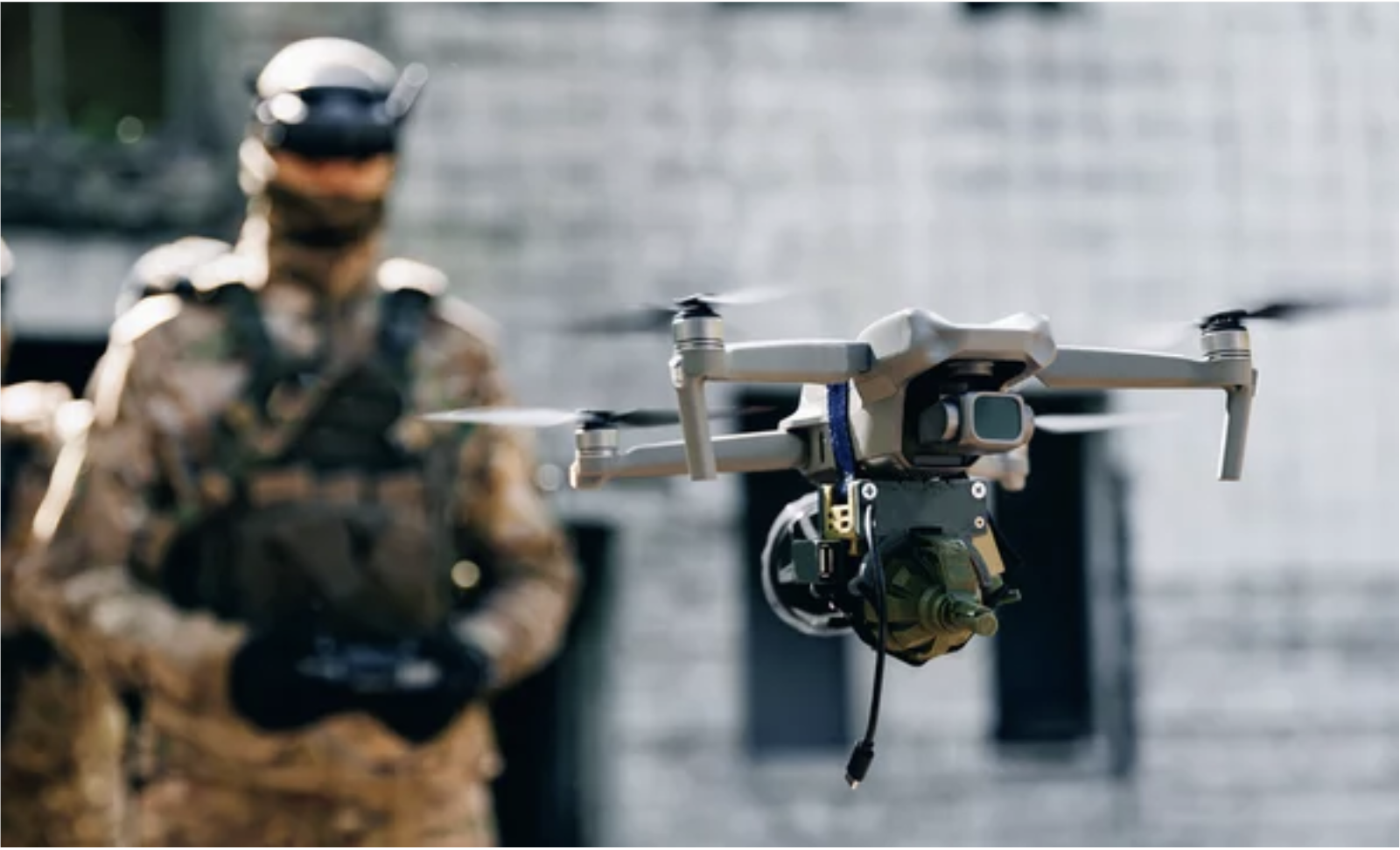
First-person view (FPV) drones, a type of quadcopter, are most suited to fast strikes. These drones are typical civilian models which are assembled and rigged with grenades. FPV drones are ubiquitous, but hard to operate and easy to shoot down. Camera quality is poor, so the use of Orlan-10 drones to locate targets is again a necessity. FPV drones can be effective at striking armored vehicles, but there are various methods of countering these strikes. Decoys can imitate expensive armored vehicles that need to be protected. Jammers can be placed on or near armored vehicles to interfere with the signal of FPV drones.
Medium altitude long endurance drones can also be armed with bombs and guided missiles. The Forpost-R, produced in Russia under an Israeli license, and the HESA Shahed 129, made in Iran, are a few such examples. Not all these drones have satellite communications links, however, which limits the striking distance. For this reason, the Russian military hasn’t used many medium altitude long endurance drones against Ukraine.
It can be debated whether cruise missiles are in fact drones, because they operate on fixed targets. However, cruise missiles are relevant to the Russian invasion of Ukraine, which makes them worthy of discussion. Cruise missiles can be thought of as slow, highly lethal versions of attack drones. Most notably, the HESA Shahed 136, produced by Iran, has been used to ruinous effect against Ukraine. The HESA Shahed 136 is a suicide drone typically launched in swarms against large targets in pre-planned attacks. Western nations have attempted to produce substitutes, but the Iranian model is cheaper and faster to assemble than any similar missile on the market.
In addition to stockpiling drones, the Russians have also been successful in terms of strategy. Swarming is one method that is indicative of how Russian drone warfare is developing. Swarming can be defined as launching an abundance of low-cost drones, which will entail a significant loss of resources, but increases the rate of success. For now, only the HESA Shahed 136 has reportedly been used in swarms. Increasing production of loitering munitions could make swarming more common, however. The proliferation of drones may eventually replace the need for missiles and guns, since swarms of drones are cheaper and highly precise. Another future possibility is the expansion of network-centric warfare, which could entail swarming in tandem with manned aircraft.
The Ministry of Defense (MOD) has exhibited some telltale signs of planning for such a future. Prior to the invasion of Ukraine, the MOD was integrating autonomous systems for precision strikes into their drone arsenal. Furthermore, Russian military academies and research institutions associated with the MOD began testing the influence of artificial intelligence on drones launched into common airspace. More recently, the MOD has equipped drones with catalogues detecting NATO munitions. The Ukraine invasion has accelerated the MOD’s development of Russian drone strategy, plowing forward under dubious moral pretexts.
Drones raise numerous ethical concerns. Proponents often cite self-defense to justify drone strikes. Others would argue that drone strikes violate International Humanitarian Law because they pose the unintended consequence of killing civilians. One solution is to attach video cameras to drones, increasing the level of human intervention involved in carrying out signature and other types of strikes. However, drone operators are prone to moral distress in the process. Unlike combatants in the field, drone operators develop a level of intimacy with targets, yet they still are confronted with the consequences of their actions on a screen. By observing signs of humanity in a target, operators can back down from executing strikes.
Another possibility is offloading responsibility to AI. Personnel would no longer be needed to operate drones, and communication issues would be eliminated. Arguably, since humans do not always adhere to ethical standards in war, AI could demonstrate a more rigid compliance with International Humanitarian Law. On the other hand, only humans can comprehend ethical determinations. AI technologies are not moral actors and cannot be held accountable for their wrongful acts.
Russia has shown a tendency to forego the ethics code by which other nations operate, and there is reason to believe that they could do the same with drones. The aforementioned concerns regarding drone ethics, collateral damage, and ethical AI use might just be more wartime norms that Russia oversteps.
One solution to mitigate heightened Russian drone aggression is to invest in drone defense facilities and technology. The EU has expressed interest in the assembly of a drone wall, a patchwork of sensors and counter drone weapons on the eastern border that would detect and destroy Russian drones. However, the project would be an expensive undertaking, and there is no known timeline yet. Whether or not the wall is a successful endeavor, Russia’s mission is to divide EU and NATO member nations, so a coordinated effort will be a necessary provision against Russian military aggression. Disparate actors funding their preferred solutions will only cause confusion and leave regions vulnerable to drone incursions.
Notes
- Bendett, Samuel. “Russian Military Drones: Established and Emerging Technologies in Ukraine.” In De Gruyter Handbook of Drone Warfare, First edition, edited by James Patton Rogers, vol. 4. De Gruyter Contemporary Social Sciences Handbooks. De Gruyter, 2024. http://pi.lib.uchicago.edu/1001/cat/bib/14151221.
- Birsel, Robert, and Shane Croucher. “Putin Ally Responds to NATO Drone Swarms: ‘Dumb Animals.’” World. Newsweek, October 6, 2025. https://www.newsweek.com/putin-russia-drones-nato-europe-war-10831927.
- Brady, Kate, and Aaron Wiener. “Drones Test Europe’s Readiness for Russian Attacks — and for Disinformation.” World. The Washington Post, October 22, 2025. https://www.washingtonpost.com/world/2025/10/22/russia-drones-europe-disinformation/.
- Celander, Lars. How Drones Fight: How Small Drones Are Revolutionizing Warfare. Casemate Publishers & Book Distributors, 2024.
- Enemark, Christian. Moralities of Drone Violence. Edinburgh University Press, 2023. http://pi.lib.uchicago.edu/1001/cat/bib/14355714.
- Gross, Jenny. “What We Know About the Drone Sightings in Europe.” Europe. The New York Times, October 22, 2025. https://www.nytimes.com/2025/10/22/world/europe/drone-sightings-airports.html.
- Harding, Luke. “‘She Went through Hell’: Widow of Chornobyl Engineer Is Killed in Russian Drone Strike on Kyiv.” News. The Guardian (Kyiv, Ukraine), November 16, 2025. https://www.theguardian.com/world/2025/nov/16/nataliia-khodemchuk-widow-of-chornobyl-engineer-killed-russian-drone-strike-kyiv.
- Hennigan, W.J. “New Drone Has No Pilot Anywhere, so Who’s Accountable?” World & Nation. The Los Angeles Times, January 26, 2012. https://www.latimes.com/archives/la-xpm-2012-jan-26-la-fi-auto-drone-20120126-story.html.
- Keene, Shima D. “Lethal and Legal? The Ethics of Drone Strikes.” In Drone Warfare: Ethical Explorations (Ethical Issues in the 21st Century), edited by Michelle Holloway. Novinka, 2016.
- MacDonald, Alistair. “Every Nation Wants to Copy Iran’s Deadly Shahed Drone.” World. The Wall Street Journal, September 24, 2025. https://www.wsj.com/world/iran-shahed-drone-copy-development-f8cd8aabgaa_at=eafs&gaa_n=AWEtsqdWi7OADtoHhXILKVacWPXXK51kAwqhUv07RiUVQAldB9J8G52AvovRLmrFog0%3D&gaa_ts=68fe76e6&gaa_sig=mC4WfKbPbjvcCJvOKYR8eDnFxWayZo2Fmr-T-pTFNqkR1SDwOnZt7n37YRhLclt6MBs5EIPADkj9h9HqoDx1cw%3D%3D.
- “Navy Demonstrates Multi-Day Solar UAS Flight.” July 29, 2025. https://www.navair.navy.mil/news/Navy-demonstrates-multi-day-solar-UAS-flight/Tue-07292025-1554.
- O’Hanlon, Michael. The Future of Land Warfare. Geopolitics in the 21st Century. Broookings Institution Press, 2015. http://pi.lib.uchicago.edu/1001/cat/bib/11792178.
- Rasmussen, Sune Engel, Thomas Grove, and Karolina Jeznach. “Can Shotguns, Spy Planes and Lasers Protect Europe From the Next Drone Incursion?” World, Europe. The Wall Street Journal, October 13, 2025. https://www.wsj.com/world/europe/nato-drone-defense-plans-0accac42.
- Risen, Clay. “As Suspicious Drones Plague Germany, Officials Are Unsure How to Respond.” Europe. The New York Times, October 22, 2025. https://www.nytimes.com/2025/10/22/world/europe/germany-drones-defense-russia.html?searchResultPosition=6.