Soviet Nostalgia and Eurasianism in Putin’s Russia

Oliver Go, University of Chicago
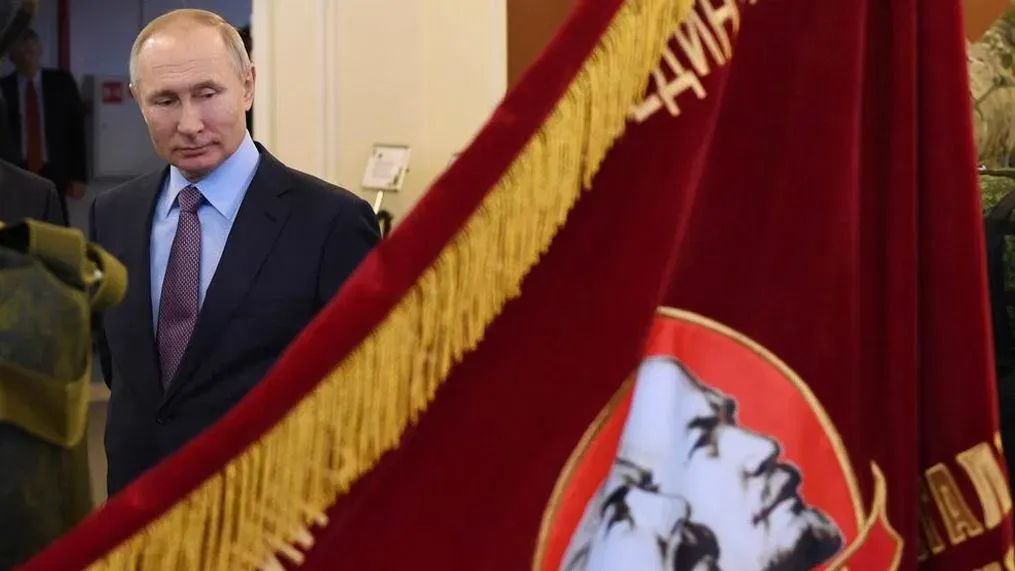
The specter of the Soviet Union has consistently haunted the Russian Federation in its thirty years of existence. Soviet nostalgia, a cultural phenomenon that ripples through Eastern Europe and the Caucasus, is most evident in Russia, where Vladimir Putin has been a major political figure since 1999. Putin himself has never combated Soviet nostalgia; in fact, he has utilized aspects of it several times throughout his political career. In 2000, for example, he resuscitated the Soviet national anthem with some new verses for the anthem of the Russian Federation. In the midst of the invasion of Ukraine, questions have arisen about whether Putin’s strategic endgame is a revival of the Soviet Union, a socialist state restored to its former borders. But while Putin uses Soviet nostalgia as a method to raise support among the Russian people, his goals lie in Tsarist origins that precede the Russian Revolution, rooted in the ideology of Eurasianism rather than communism or socialism.
Twenty years ago, Putin declared in his annual state of the nation address that “the demise of the Soviet Union was the greatest geopolitical catastrophe of the century.” In the immediate post-Soviet period, Russia experienced double-digit rates of inflation. Putin’s positive view of the Soviet Union’s importance in Russian history has been consistent throughout his many years as Russia’s paramount leader. Putin’s views in this regard align with a majority of the Russian population. A 2015 poll from the Pew Research Center revealed that 69% of Russians felt that the breakup of the Soviet Union was a net negative for the nation, and another Pew poll from 2016 showed that 58% of Russians believed Stalin played a positive role in Russian history (in contrast to Gorbachev’s paltry 22%). In 2021, about 46% of the population identified more with the Soviet Union than the Russian Federation, a percentage that had been increasing since the annexation of Crimea in 2014. At the annual Channel One hockey game in 2021, the Russian team wore the old Soviet uniforms (with the Cyrillic abbreviation for the Soviet Union, CCCP, across their jerseys) for their game, and the Soviet flag was often flown in the audience.
Perhaps one of the strongest examples of the Putin government’s endorsement of Soviet nostalgia is its attempt to control the historical narratives surrounding the Soviet era. The memory and legacy of Stalin is one of the subjects that has been most altered in this campaign. Two new textbooks were promoted in 2007 as core history textbooks required for Russian upper schools. These textbooks whitewashed Stalin’s purges and political oppression in the 1930s, portraying them as necessary in the face of fascism and justified because of their importance in the German invasion: “Stalin was acting in a concrete-historical situation, behaving … entirely rationally as the persistent advocate of the transformation of the country into an industrial power, directed from a single center, and as the leader of a country which would face the threat of war in the very near future.” In explaining Stalin’s prewar actions as being part of preparation against the Nazis, these textbooks change the narrative around Stalin’s rule.
Changing history centered around the Stalin era reveals the most crucial element to Putin’s Soviet nostalgia: the moral importance of the Second World War, a war that was scarring for the entire world but especially for the Soviet Union, where 25 million Soviets died. An article published under Putin’s name in the National Interest, released on the 75th anniversary of the war’s end, highlights the importance of WWII for Russia: the Second World War was deeply personal, and therefore an immensely powerful victory for the Russian people. It was a war won by “the love for their homeland, their Motherland. That deep-seated, intimate feeling is fully reflected in the very essence of [Russia] and became one of the decisive factors in its heroic, sacrificial fight against the Nazis.” The Second World War is so culturally important to Russian history that vilifying the Soviet Union during the Stalin Era is, in a sense, a direct condemnation of the efforts against the Nazis themselves.
The Second World War being an integral part of Russian identity today is essential to understanding Putin’s justification for the invasion of Ukraine. In his address on February 24th, 2022, Putin referred to “the far-right nationalists and neo-Nazis in Ukraine” and declared his goal to “demilitarize and denazify Ukraine”, citing the “sacrifices our people had to make to defeat Nazism” to justify his choice for military action. Putin called back memories of the Second World War by calling to Ukrainian military officers to remember their grandparents who fought the Axis powers: “Your fathers, grandfathers, and great-grandfathers did not fight the Nazi occupiers and did not defend our common Motherland to allow today’s neo-Nazis to seize power in Ukraine.” Generally, it seems as though the Russian people do approve of the war in Ukraine, proving some effectiveness in Putin’s justifications. In conjuring up national memories of both tragedy and absolute victory, the chief achievement of the Soviet Union was used by Putin to gather support for the invasion of Ukraine.
Because of his political actions and rhetoric, images have emerged of Putin as a figure obsessed with the reconstruction of the Soviet Union and its strength in comparison to Yeltsin’s Russia, the country he inherited when he became Prime Minister in 1999. But while Putin looks fondly on the Soviet Union and has taken steps to protect its memory, his goals do not consist of recreating it. Rather, Putinism takes its geopolitical goals from the ideology of Eurasianism. If there were to be a goal of returning to any historical period in Putin’s ambitions, it would be a reconstruction of tsarist Russia. The collapse of the Soviet Union was not a tragedy for Putin because of the death of the Soviet state itself, but rather because it meant “the dissolution of historical Russia under the name of the Soviet Union… what had been built up over 1,000 years was largely lost.” For Putin, the Soviet Union’s collapse was a disaster in terms of what it meant for Russia’s longer history. He connected the Soviet Union to the larger legacy of the Russian tsars, contrary to how the Soviets viewed themselves in relation to the Russian Empire. The connection of the Soviet Union to a larger narrative of Russia as a nation (though not a single state) is reminiscent of Eurasianism, which has appeared in several facets of Putinist Russia’s ideology.
Eurasianism is an ideology originating in Russia through White Russian emigrés in the aftermath of their defeat in the Russian Civil War. The philosophy argues that Russia is not merely a periphery country of the European continent but, in actuality, belongs to its own continent called Eurasia, which is special because of its fusion of European and Asian influences. In this Eurasian worldview, the Soviet Union was not that different a political state from tsarist Russia in ideology, because both states still served the interests of the Eurasian identity. In Putin’s comments, the connection of tsarist Russia to the Soviet Union is consistent with Eurasian ideas. The neo-Eurasian ideology, which emerged in the 1990s in post-Soviet Russia, expanded the concept of Eurasia by including all the former Soviet countries as parts of Eurasia. This expansion puts Putin’s other complaint of the Soviet collapse, that they “had turned into a completely different country” in the breakup, into perspective. Within the first few paragraphs of the Russian Federation’s approved 2023 concept of foreign policy statement, the term and idea of “Eurasia” as a real alternative to simply just “Europe and Asia” appears, where the writers “determine Russia's special position as a unique country-civilization and a vast Eurasian and Euro-Pacific power that brings together the Russian people and other peoples belonging to the cultural and civilizational community of the Russian world.”
Equally important in the Eurasian influences of Putin’s ideology is his love for tsarist Russia. When asked by a Financial Times reporter which world leader he admired the most, Putin answered “Peter the Great,” and said that “he will live as long as his cause is alive.” When he was deputy mayor of Saint Petersburg in the post-Soviet 1990s, the portrait that hung on his office wall was of that tsar. In a 5,000-word essay titled “On the Historical Unity of Russians and Ukrainians”, Putin wrote that Russians, Ukrainians, and Belarusians all originated from the medieval Kievan Rus, spoke the same language, and all practiced Orthodoxy and participated in the same church. He claimed that the only reason that Ukraine exists as a separate idea today is because of the Soviet Union, “entirely the product of the Soviet era” even though “it was shaped on the lands of historical Russia.” Therefore, “it is enough to look at the boundaries of the lands reunited with the Russian state in the 17th century” under the conquests of Peter the Great as the true borders of Russia as a cultural entity.
It is for this reason that Putin cannot possibly originate his political goals in Soviet thought. Putin finds severe ideological faults with the Soviet Union and therefore prefers tsarist Russia to the Soviets for inspiration, as the Marxist origins of Soviet ideology make them a rivaling ideology against Eurasianism. The internationalism inherent to the former makes them an incompatible force to the latter, which views Russia as a special civilization and culture. In his declaration of war on Ukraine, Putin claimed that “Soviet Ukraine is the result of the Bolsheviks’ policy and can rightfully be called ‘Vladimir Lenin’s Ukraine.’ He was its creator and architect.” This claim would factor into his critique of modern Ukraine as being an artificial creation of the Soviets. Soviet ideology is not just incompatible with Putin’s current views, but more specifically an enemy of his philosophy, having (in Putin’s view) created the very state that threatens a united Russia today. In comparison, the military accomplishments of the tsars, most of all those of Peter the Great, are what inspire the idea that Ukraine and other post-Soviet states are parts of a “lost Russia”, in need of a great gatherer like Ivan the Terrible.
Putin’s admiration for Peter the Great goes beyond just idolization of a historical figure. Rather than seeing Putin’s love of Peter the Great as simply a personal obsession, admiration of Peter is essential to Putin connecting his rule to the grander narrative of Russian history. In 2022, Putin stated that, in annexing parts of Sweden after the Great Northern War of 1700-1721, Peter the Great “did not take anything from [the Swedes], he returned [what was Russia’s]... Apparently, it is also our lot to return [what is Russia’s] and strengthen [the country].” In his circulation back to Peter the Great to justify the conquest of Ukraine, Putin uses his political idol to connect Eurasianist elements (the concept of a cultural and ethnic Russia larger than simple political borders) and Russian history to forge an image of modern Russia as being an irredentist force akin to Peter the Great’s mission. Peter the Great is more than just a personal hero: his victories are a blueprint for how Russia should and ought to look in terms of its political borders.
Peter the Great is not the only Russian hero in Putinist Russia: Ivan the Great and his son/successor Ivan the Terrible, widely recognized as the founding figures of the Russian Empire, were hailed by Putin as the “great gatherers of the [lost] lands of Rus’”, while he quoted Catherine the Great, the empress who conquered many parts of Ukraine (including Crimea), in reference to his invasion of the country. The connection running through all of these figures is their role in creating Russia as understood through a Eurasianist lens, with cultural and ethnic borders that transcend mere political ones. It is through the history of the Russian Empire that Putin finds that Ukraine is a culturally Russian region and therefore should be incorporated into Russia. In late November of 2025, a newly released Russian government document titled "Strategy of Russia's national policy in the period to 2036” expresses intentions to ensure that 95% of Ukraine’s population identify as Russian by 2036. The imperial history of Russia provides the basis to understand Ukraine as a region belonging de jure to Russia’s cultural borders, a conception originating in Eurasianism.
If Putin is truly an agent of Eurasianism, trying to recreate Peter’s glory in the 21st century, the present danger lies in our misinterpretations of Russian foreign policy based on the Soviet nostalgia element of Putin’s public image. While Putin does use elements of Soviet nostalgia to heighten his popularity and strengthen his image, it would be a falsehood to view the Russian Federation as pursuing the same goals as the Soviet Union. For example, Russian funding in foreign countries should not be viewed as attempts to build a new global coalition that will defeat Western civilization or capitalism, but instead to construct a sphere of Russian hegemony and dominance.
Perhaps the most important issue in this question is what the Russian alliance with China means in ideological terms. Through the lens of seeing Putin as a neo-Soviet leader, Russia-China relations today may be seen as a rebuilding of the alliance of Mao and Stalin; however, in the understanding of the Eurasian influences on Putinism, an alliance that sees China and Russia as ideological equals is unlikely. Most likely, the alliance of Russia and China is not based on any ideological unity (as was the Soviet-Chinese relationship before the Sino-Soviet Split) but rather out of practicality and realpolitik. China ought not to interfere with any part of Eurasia in the Eurasianist understanding. From this arises the question of whether the Belt and Road Initiative will cause a drift in Russo-Chinese relations.
China’s Belt and Road Initiative is an economic plan that seeks to provide funding for infrastructure projects across the world that promote integration and connectivity between nations, particularly between China and Europe. The project has been seen as a power play by China to gain the ability to economically pressure various countries to counter US economic power. Where the BRI may conflict with Russian and Chinese interests is in Central Asia, where a majority of BRI projects have been focused on connecting Europe and Asia through land routes. In the eyes of modern Eurasianists like Alexander Dugin, the most famous Eurasianist political philosopher today, Central Asia is a region that ought to be unified with Russia as a crucial area in creating a new Eurasian empire. If Central Asia is a core part of cultural Russia, the expansion of Chinese influence into states in this region would be a serious worry for Putin and others interested in rebuilding Russia in the mold of Eurasianism and neo-imperialism. Whether the BRI in Central Asia will conflict with Eurasianist interests is yet to be seen.
As displayed in its interest in Central Asia, Eurasianism does not stop with Ukraine. The grand vision of a Russian civilization beyond its current political borders will not be completed with the annexation of Ukraine. The tsarist and Eurasianist influences in Putin’s political philosophy leave unanswered questions as to how Russian actions should be understood in Eastern Europe, as well as whether warm Russo-Chinese relations are at risk if Eurasian irredentism comes to the forefront of their relationship. While Putin’s usage of Soviet nostalgia is eye-catching and apparent, it should be properly understood as only a political tool used by Putin, while his actual ideology is based in philosophies that precede and contradict Soviet thought.
Notes
- “Address by the President of the Russian Federation.” President of Russia, February 24, 2022. http://en.kremlin.ru/events/president/news/67843.
- Avdaliani, Emil. “The Rise of Chinese Eurasianism.” Begin-Sadat Center for Strategic Studies, August 19, 2018. https://besacenter.org/china-eurasianism/.
- Chaisty, Paul, and Stephen Whitefield. “Expert Comment: Putin’s Russia.” University of Oxford, April 21, 2022. https://www.ox.ac.uk/news/2022-04-21-expert-comment-putin-s-russia-people-increasingly-identify-soviet-union-here-s-what.
- “The Concept of the Foreign Policy of the Russian Federation.” Wayback Machine, March 31, 2023. https://web.archive.org/web/20230410161817/https:/russiaeu.ru/en/news/concept-foreign-policy-russian-federation.
- Durand, Olivia. “Ukraine Invasion Suggests Putin Is More Vladimir the Reactionary than Peter the Great.” The Conversation, June 30, 2022. https://theconversation.com/ukraine-invasion-suggests-putin-is-more-vladimir-the-reactionary-than-peter-the-great-186133.
- Gentleman, Amelia. “Intelligentsia Revolts as Putin Brings Back Soviet Anthem.” The Guardian, December 6, 2000. https://www.theguardian.com/world/2000/dec/06/russia.ameliagentleman.
- Glasser, Susan B. “Putin the Great: Russia’s Imperial Impostor.” Foreign Affairs 98, no. 5 (2019): 10–17. https://www.jstor.org/stable/26798245.
- Klump, Sarah Dixon. “Russian Eurasianism: An Ideology of Empire.” Wilson Center, July 7, 2011. https://www.wilsoncenter.org/publication/russian-eurasianism-ideology-empire.
- Kolesnikov, Andrei. “Opinion: Thirty Years after the Soviet Union Collapsed, Putin Exploits Nostalgia for the Old Regime.” CNN, December 26, 2021. https://edition.cnn.com/2021/12/25/opinions/30th-anniversary-soviet-union-collapse-andrei-kolesnikov.
- Mackenzie, Matthew F. “Putin’s Eurasianist Vision.” Foreign Policy Association. Accessed November 30, 2025. https://fpa.org/putins-eurasianist-vision/.
- Masci, David. “In Russia, Nostalgia for Soviet Union and Positive Feelings about Stalin.” Pew Research Center, June 29, 2017. https://www.pewresearch.org/short-reads/2017/06/29/in-russia-nostalgia-for-soviet-union-and-positive-feelings-about-stalin/.
- Osborn, Andrew, and Andrey Ostroukh. “Putin Rues Soviet Collapse as Demise of ‘Historical Russia.’” Reuters, December 12, 2021. https://www.reuters.com/world/europe/putin-rues-soviet-collapse-demise-historical-russia-2021-12-12/.
- “Putin Says Authorities Must ‘strengthen’ Russian Identity in Ukraine.” Reuters, November 26, 2025. https://www.reuters.com/world/europe/putin-says-authorities-must-galvanise-russian-identity-ukraine-2025-11-26/.
- “Putin: Soviet Collapse a ‘Genuine Tragedy.’” NBC News, April 25, 2005. https://www.nbcnews.com/id/wbna7632057.
- Putin, Vladimir. “On the Historical Unity of Russians and Ukrainians.” President of Russia, July 12, 2021. http://en.kremlin.ru/events/president/news/66181.
- Putin, Vladimir. “The Real Lessons of the 75th Anniversary of World War II.” The National Interest, June 18, 2020. https://nationalinterest.org/feature/vladimir-putin-real-lessons-75th-anniversary-world-war-ii-162982.
- “Research Starters: Worldwide Deaths in World War II.” The National WWII Museum. Accessed November 30, 2025. https://www.nationalww2museum.org/students-teachers/student-resources/research-starters/research-starters-worldwide-deaths-world-war.
- Roth, Andrew. “Putin Compares Himself to Peter the Great in Quest to Take Back Russian Lands.” The Guardian, June 10, 2022. https://www.theguardian.com/world/2022/jun/10/putin-compares-himself-to-peter-the-great-in-quest-to-take-back-russian-lands.
- Sherlock, Thomas. “Russian Politics and the Soviet Past: Reassessing Stalin and Stalinism under Vladimir Putin.” Communist and Post-Communist Studies 49, no. 1 (2016): 45–59. https://www.jstor.org/stable/48610433.
- Shlapentokh, Dmitry. “Dugin, Eurasianism, and Central Asia.” Communist and Post-Communist Studies 40, no. 2 (2007): 143–156. https://www.sciencedirect.com/science/article/abs/pii/S0967067X07000190.
- Snegovaya, Maria. “The Reluctant Consensus: War and Russia’s Public Opinion.” Atlantic Council, December 17, 2024. https://www.atlanticcouncil.org/content-series/russia-tomorrow/reluctant-consensus-war-and-russias-public-opinion/.