The United Arab Emirates’ Surrogate Network Building in Sudan and Yemen as Power Projection and State Identity Building

Ayoub Wadood, University of Chicago
In Sudan and Yemen, two very different types of conflict rage on. In the former, a bloody civil war emerged from disunity in the country’s military cliques, supplanted by cleavages formed by earlier ethnic conflict. In the latter, spurned tribal groups couped the internationally recognized government in the North, while old communist dissolution grievances in the South gave way to secessionist rule. Key commonalities do emerge: both states are Arabic-speaking, and both wars are marked by the United Arab Emirates (UAE) supporting non-state actors. The United Arab Emirates, situated in the Persian Gulf, away from the Nile and the Gulf of Aden, is involved in these conflicts, but the question remains as to why this involvement arose and why it persists.
States, structural realists argue, seek security. What this security looks like is variable and has been imagined differently by many theorists. John Mearsheimer argues in The Tragedy of Great Power Politics that states seek security through regional hegemony, the accrual of wealth, land power, and nuclear weapon supremacy. Although the UAE’s actions of influence-building in Sudan and Yemen can be explained through the seeking of regional hegemony and wealth, this theory fails to address an additional mechanism dictating the state’s foreign policy: the assurance of an independent state identity through conflict intervention and influence.
The UAE’s involvement in these conflicts primarily serves to project its own influence beyond the Gulf Cooperation Council (GCC), reflecting an aggregative practice of state identity-building that prevents subsumption into the broader Gulf and Arab game of politics, and reaching past the status of a mere federation of emirates.
By accumulating surrogates and clients in the Arabic-speaking world through support of factions in civil war, the UAE seeks to achieve regional ascendancy and, consequently, assurance of continued statehood. The Emirates do indeed pursue a policy of foreign intervention to satisfy material gains and project power. The bellicose nature of Emirati influence-building characterizes the offensive-realist dimension to the Emirates’ foreign strategy, but this is not the defining reason as to why this strategy is taken. The existential, identity-based considerations the UAE faces inform its actions in pursuing and maintaining state independence. By pursuing a foreign strategy around conflict intervention and presence, separate from diplomatic and policy directives of other GCC states, the Emirates construct an Emirati state identity.
The Identity Angle and Maximizing Power Projection as a Gulf State
Situated at the edge of the Arabian Peninsula in the Lower Persian Gulf, the UAE certainly contends with geopolitical realities that would induce anxiety in a sovereign state concerned with self-perpetuation. The Emirates is sandwiched between two regional powers that are not at all cordial with each other: Saudi Arabia and Iran. Beyond the existential risk this crossfire poses, the Emirates is also a member of the GCC, the regional framework binding the Arab monarchies of the Persian Gulf – Kuwait, Saudi Arabia, Bahrain, Qatar, the United Arab Emirates, and Oman. Of these states, Saudi Arabia has held the lion’s share of economic, military, and political influence. In an analysis of the changing dynamics within the GCC, Shahbaz and Hassaniyan argue that although Saudi Arabia’s possession of the dominant role in the GCC has allowed the state to make and negotiate foreign policy decisions on behalf of the collective in the past, Qatar, Oman, and the UAE have been making strides in the recent decades to pursue their own foreign policy interests against this general trend of Saudi domination.
There are two currents, in the case of the UAE, as to why a state would not be resigned to simply occupy this peripheral position in the GCC, subservient in some capacity to the Saudi state. One is the anxiety described by the aforementioned structural realists: if power can assure a state’s security in an anarchic system and power is relative and zero-sum, then the emphasized role of Saudi Arabia in the GCC thereby reduces the power of the Emirates and consequently makes the idea of the Emirates as a sovereign entity much more transient. The GCC, as the medium in which this power dynamic is played out, becomes an unattractive endpoint for a state, and the state, seeking security, might consider alternative options, pursuing regional hegemony and accruing wealth, to counteract the ‘threat’ of other states’ power in a system of relative gains. As such, the UAE is incentivized to create regional networks to underlie a nascent transformation to regional hegemon.
These currents offer an explanation as to why the Emirates may pursue a strategy of regional hegemony, but there remain gaps in the entire picture. It does not explain why other smaller states in the GCC, such as Kuwait or Bahrain, have not pursued a similar strategy of axis-construction or other forms of power maximization. What nudges the Emirates in this direction is the search for a state identity away from the rest of the GCC, and it is this existential insecurity that motivates the Emirates to pursue its foreign policy of influence building, as opposed to a mere desire to accumulate resources and project military power.
The Gulf nation-state is a precarious thing. In Fred Halliday’s 1974 Arabia without Sultans, he explicates on the creation of the Gulf state, which he describes as tribal structures consolidated through patronage by colonial entities. In particular, the Trucial States [the UAE’s predecessor entity] were solidified as an entity against Omani suzerainty through this system. The Emirates, consequently, have to justify their collective nationhood both as a Gulf state and as a federation of former petty states. To further consolidate its identity as a state, the UAE projects influence internationally; wealth accumulation and hegemony function as useful security assurances alongside this quest for identity. The “self” and the “other” are key in identity formation, as conceded by Wendt’s explanation of Hobbesian anarchy: “the Other is now inside the cognitive boundary of the Self, constituting who it sees itself as in relation to the Other, its ‘Me.’ It is only with this degree of internalization that a norm really constructs agents; prior to this point, their identities and interests are exogenous to it.” In the case of the state and its construction, the parallels are clear. The state constitutes itself, and its identity, through what it is not. By going against the foreign policy directive of the GCC, and particularly the Saudi state, the Emirati identity is constructed.
Two examples of the UAE’s foreign policy outline both the partial realist material framework and the quest for identity against the other states of the Persian Gulf and the broader Middle East: support of the Southern Transitional Council secessionists in Yemen, and clandestine support of the Rapid Support Forces paramilitary in Sudan.
The Southern Transitional Council and the Saudi-Emirati Fallout over the Yemen War
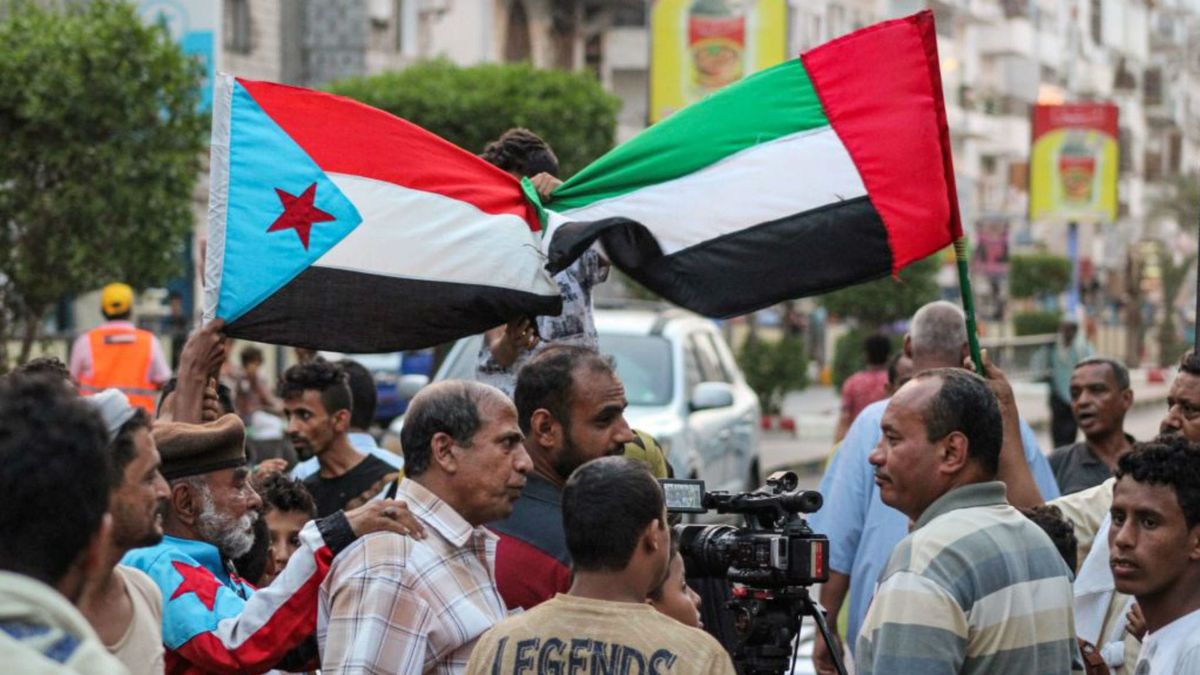
In Yemen, a three-way civil war has endured for over a decade. A stalemate between the internationally recognized government (IRG) and the Supreme Political Council, accompanied by the predominantly Zayidi Shi’ite Houthi movement, persists. In the South, the IRG crumbles as Southern secessionists led by the Southern Transitional Council (STC) aim to re-establish a sovereign South Yemeni (or South Arabian) state. The STC owes much of its success and coordination to the UAE, and the secessionist organization now controls large parts of the former South Yemen. The IRG is broadly supported by a coalition of states led by Saudi Arabia, but the UAE’s position of supporting Southern secessionists has put it at direct odds with Saudi Arabia’s foreign policy approach to Yemen, in which Yemen is to be governed whole by a Saudi-aligned faction as opposed to an Iranian one or a two-state Yemen.
There are two factors at play here. There is the material angle as discussed, and this features often in discussions around secessionism and control in Yemen’s South. The Southern governorates are oil-rich, and there is a simple, effective logic behind the desire to be in control of these resources, even if through a regional affiliate or allied militia. Having access to the large fields of hydrocarbons in a world of energy-based dominance, particularly for a petro-state, speaks for itself. From the Tragedy of Great Power Politics perspective, the UAE is bolstering its security and ontological statehood by pursuing wealth in the region – in the form of hydrocarbon access – and also through a pursuit of regional hegemony by curating a network of allied militant organizations in Yemen (principally represented by the STC).
But an important distinction here is that the UAE is pursuing the strategy of supporting Southern secessionists directly against the wishes of Saudi Arabia and Saudi Arabia’s vision of the IRG. The STC leaders have some seats in the IRG as an ostensibly compromissory measure to maintain the fragile anti-Houthi coalition. This action does indeed benefit the UAE: its clients can leverage their power in what was once Saudi Arabia’s project for Yemen, and of course, this directly projects Emirati influence.
The act of nurturing factions opposed to a more Saudi-compliant vision of Yemen challenges both Saudi hegemony in the Arabian Peninsula and Saudi Arabia’s position within the GCC as the dominant constituent state. No longer are the Emirates just another synthetic Gulf emirate following the lead of the Kingdom, but instead a policy-setting power in its own right in opposition to the other states of the Persian Gulf. There can be an argument made that by having STC officials be included within the IRG framework, the UAE avoids direct conflict with Saudi Arabia and defers at least somewhat to the state that once directed the GCC.
But the STC’s power-sharing represents only one facet of Emirati influence in Yemen; Emirati support of factions directly opposed to Saudi-specific aspirations in the Hadramut region of Southern Yemen has only intensified in recent years. In December of 2025, this turned into outright combat between UAE-backed separatists and Saudi-backed tribal forces in a campaign for the Hadramut. From this, it is clear that the UAE is dedicated to pursuing its own foreign policy interests, as opposed to Saudi Arabia’s. Through this identification of the ‘self’ and the ‘other’, the UAE develops an identity of its own.
The Rapid Support Forces and the Emirates
Sudan is currently trapped in a cycle of atrocity beget from a civil war that emerged in 2023. The internationally recognized Sudanese forces fight against the Rapid Support Forces (RSF) – a paramilitary that was preceded by the Janjaweed militia that perpetrated genocide in Darfur and seemed poised to reproduce that violence. The UAE is believed to be the backer of the RSF, as well as the beneficiary of RSF mining operations and spoils of war (particularly gold).
There is once again a simple argument to be made about security-seeking through the accumulation of wealth and through the proliferation of allied surrogates underlying a transformation to regional hegemon. Sudan is a mineral-rich country, replete with gold and other tradeable signifiers of wealth. To covet those resources is the interest of a state seeking security through affluence. Cultivating the RSF functions as a sort of military dominance in the region, and through these militant networks, the UAE may gain some semblance of Middle East ascendancy. For the structural realist, Sudan’s proxy civil war is an expected cost of the anarchic system: the practice of other states engaging in their own pursuit of security through maximizing their own power rears itself into the quagmire that is played out today. These collectively comprise a cogent argument that functions well within the guiding framework of structural realism.
However, there still remains the consideration of the Emirates’ search for and construction of identity. In the case of the STC, the UAE was reacting to the policy set by Saudi Arabia after years of overt Saudi influence in Yemen. The STC was a case of reactive foreign policy in the pursuit of identifying the self; support of the RSF demonstrates the UAE’s proactive foreign strategy. The decision to support the RSF is not divorced from the larger conversation of self in the context of the GCC and Saudi Arabia. There are no coalition-wide struggles to restore a Saudi-backed government in Sudan as there are in Yemen, but this is precisely why this is important to the UAE’s self-identification as a state beyond the mold of the GCC. By taking a stance unmirrored by other states in the region, the UAE asserts itself as a sovereign entity unbound by its respective regional frameworks and the pre-established regional powers contained in them. It takes its own identity through foreign policy decisions unshared by others, predicated on ontology through relations of the self. Its idea of the self is constructed through the idea that it does what others do not, allowing ‘personhood’ (insofar as the concept of personhood has parallels to the state).
States embody the concept of the ‘self’ much as humans might do. Through acts of individuality, humans distinguish themselves from the collective through many means: actions, desires, and aspirations. When the sense of self is threatened and overwhelmed by a potential threat of subsumption, one might engage in action to reassert a sense of being. The state is the same, and although the state has physical existential concerns (territoriality), there is also the existentiality of identity that it must contend with. This is particularly resonant in the post-colonial order of nation-states predicated on the idea that identities’ rights to self-determination are the ultimate grantor of statehood. This is what shapes the Emirates’ foreign policy: a desire for material security as well as the search for the self.
Notes
- Augustin, Anne-Linda Amira. South Yemen’s Independence Struggle: Generations of Resistance. Cairo: American University in Cairo Press, 2021.
- Badi, Emadeddin. “Sudan is Caught in a Web of External Interference. So Why Is an International Response Still Lacking?” Atlantic Council, MENASource blog, December 17 2024. https://www.atlanticcouncil.org/blogs/menasource/sudan-rsf-saf-uae-intervention/
- Brumfield, Nicholas. “Fueling Instability: Hydrocarbons, Protests, and the Limits of Yemen’s Internationally Recognized Government.” Arab Center Washington DC. September 12, 2025. https://arabcenterdc.org/resource/fueling-instability-hydrocarbons-protests-and-the-limits-of-yemens-internationally-recognized-government/
- D’Agoôt, Majak. “Beyond State Capture: The Case of the Rapid Support Forces (RSF) in Sudan.” Small Wars & Insurgencies 36, no. 4 (2025): 698–726. https://doi.org/10.1080/09592318.2025.2464435
- Halliday, Fred. Arabia Without Sultans. New York: Random House, 1975.
- Jalal, Ibrahim. “Saudi-Emirati Divergences Lead Hadhramawt to a Crossroad.” Carnegie Endowment for International Peace. December 23, 2024. https://carnegieendowment.org/research/2024/12/saudi-emirati-divergences-lead-hadhramawt-to-a-crossroad
- Mearsheimer, John. The Tragedy of Great Power Politics. New York: W. W. Norton, 2001.
- Nasser, Afrah. “Divergent Saudi-Emirati Agendas Cripple Yemen’s Presidential Leadership Council.” Arab Center Washington DC. May 15, 2024. https://arabcenterdc.org/resource/divergent-saudi-emirati-agendas-cripple-yemens-presidential-leadership-council/
- Shahbaz, Ahmed A., and Allan Hassaniyan. “The Growing Autonomy for GCC States’ Foreign Policy and Structural Changes in the Balance of Power in the Region.” Asian Journal of Middle Eastern and Islamic Studies 18, no. 4 (2024): 321–39. https://doi.org/10.1080/25765949.2025.2480007
- Soliman, Ahmed, and Suliman Baldo. “03 Gold Production and Trade during the War.” In Gold and the War in Sudan: How Regional Solutions Can Support an End to Conflict. London: Chatham House, 26 March 2025. https://www.chathamhouse.org/2025/03/gold-and-war-sudan/03-gold-production-and-trade-during-war
- Uddin, Rayhan. “Yemen’s UAE-backed STC Seizes Control of City in Hadhramaut Offensive.” Middle East Eye, December 3, 2025.
- Waltz, Kenneth. “The Stability of a Bipolar World.” Daedalus 93, no. 3 (1964): 881–909.
- Waltz, Kenneth. Theory of International Politics. Reading: Addison-Wesley, 1979.
- Wendt, Alexander. Social Theory of International Politics. Cambridge: Cambridge University Press, 2006.