
Understanding Greek Refugee Management through Racial Governmentality

Ruby Velez, University of Chicago
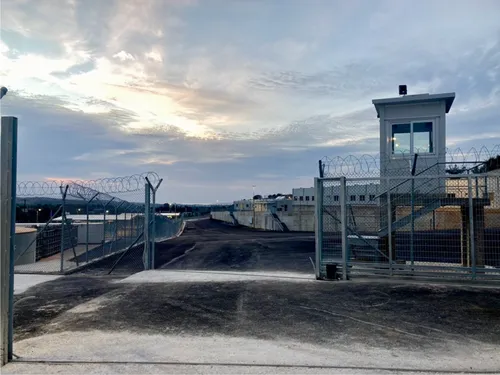
In 2021, the EU began funding Closed Controlled Access Centers (CCACs) in Greece to secure refugees. These Centers are outfitted with cutting-edge biometric surveillance technology, heavy security, and limited options for entry and exit. Despite complaints from UN agencies and rights groups, the CCAC program has been lauded by European states, and the EU has paid over €270 million to build a total of five CCAC refugee camps in remote areas across the Greek islands.
The refugee camps on the outskirts of the Schengen area, Europe’s free movement zone, are key mechanisms in keeping refugee numbers low within the European Union. But they hold dangerous implications for a new era of European migration control. To understand these potentials, I turn to critical International Relations scholars who have invoked the theories of Aníbal Quijano’s colonial modernity, and Foucauldian racial governmentality, in respect to migration management. I posit that the use of biometric surveillance as a way of managing migrant populations suggests a new incarnation of colonial modernity on the categorization not of race alone, but of the very status of refugeetude. While the EU turns to CCAC as an externalization of the continent’s refugee crisis, these novel iterations of the refugee camp can be understood as enacting a new sort of colonial modernity through specific biometric techniques of racial governmentality that shape behavior and knowledge along racial lines.
The Schengen area is a zone of free movement across borders among 29 European states, closely overlapping with the European Union (EU). After its creation in 1995, citizens of Schengen member states have enjoyed a common visa policy and largely uninhibited movement. Yet its founding ideal of a “common area of freedom, rights and security,” is upheld only through intensifying practices of separation.
Greece has been an especially common point of first entry for migrants. According to the UNHCR, the nation “has been the arrival point of 46 percent of more than 2.8 million undocumented people entering Europe” since 2015. Most of these migrants arrive with Northern states like Germany as their end destinations, and the EU has demonstrated it has a vested interest in ensuring the new arrivals remain at the margins of the continent. The European Parliament has been engaged in an active project of strengthening immigration controls through infrastructure at the Schengen area’s external borders, closely monitoring those with rejected asylum applications, and building the capacity of ‘margin’ states like Greece to hold refugees.
Recently, the EU has funded newly erected border fences and increased Frontex personnel, the EU border control force notorious for deadly ‘pushbacks’ of migrants bound for Europe across the Mediterranean. For migrants not quickly deported by Frontex, the Dublin Regulation dictates that their asylum application may only be considered in their country of first entry in the EU. Most often, this means applying in Greece, Italy, or Spain, and facing quick removal if that application is rejected. EU member states endorsed a law that passed in Greece last September, ruling that rejected asylum applicants would be fitted with ankle monitors to ensure they exit the country within two weeks of their application denial. If they fail to leave in that time frame, they face two to five years of imprisonment in closed refugee camps. Applying elsewhere in the EU is also not an option; the Schengen Information System allows member states to share data on individuals denied asylum, including facial scans, palm prints, and DNA profiles. This data is open to border control, police, customs, immigration officials, and judiciaries in each Schengen state, ensuring that if an asylum application is denied in one EU state, there is no chance for it to be reconsidered in a different jurisdiction.
For the percentage of migrants who are able to present a plausible asylum claim, the likely future awaiting them is secured behind the walls of fortified CCAC refugee camps. The five new CCACs have, in theory, increased Greece’s capacity for hosting refugees, but their structure makes clear their dual role in controlling movement. Vital infrastructure remains lacking while surveillance technologies are used alert control systems of migrants’ locations. Petra Molnar, in The Walls Have Eyes: Surviving Migration in the Age of Artificial Intelligence, discussed the Ritsona camp as an example of a new form of refugee management, one that relied on state-of-the-art digital surveillance tools paired with abysmal living conditions. A few days before the camp opened, Molnar noted, it had no running water, but was equipped with fingerprint readers at points of entry. Similarly, the Samos CCAC was originally built to hold 2,040 people, but has been consistently overcrowded since its opening, to a peak of 4,850 detainees in January 2024. Here, water shortages, contaminated food, and a lack of medical services were commonplace. In one instance, conditions were so poor in Greek asylum facilities that the ECHR no longer allowed countries to repatriate refugees there. One man who was held on Samos for two years told humanitarian workers, “They take funds to keep us here as prisoners.” The priorities are clear here: more funds are diverted to the collection of biometric information, strengthening Greek and EU command over movement, than to the basic life-needs of those held within refugee camps.
This sort of biometric surveillance can be considered a new expansion of racial governmentality. Governmentality, as explained in Foucault’s 1978 lectures, can be understood as how the government acts as both an intervention to societal needs and an influence over the conduct of the self through the use of knowledge that gradually shapes behaviors. Foucault gave two primary categories of tactics for governmentality: disciplinary power enacted through institutions that surveil, punish, and make rules; and biopolitics as the collection of information and statistics on a population in a way that enables the state to effectively manage it. Racial governmentality specifically analyzes how these institutions and management procedures have magnified racial classifications, both explicitly and implicitly. Governmentality specifically shows how securitized populations, like migrants, are addressed not only through one-time exceptional measures, but through sometimes banal processes of everyday population management.
Immigrants have long been subjected to experimentation of new carceral technologies, and refugee camps have long held a specifically vulnerable population as a test site, but never before have institutions been able to collect such detailed and comprehensive biometric information on migrant subjects. In addition to Ritsona, other refugee camps on the Greek islands of Samos and Kos feature “biometric turnstiles, motion-detection and risk-analysis algorithms, and drone surveillance." The expansion of technologies like fingerprint readers, smart joystick-controlled cameras, and even virtual reality glasses for camp guards allows camps to constantly monitor the physical location of their refugee residents. This undeniably constitutes a sort of governmentality. Molnar documents how these infrastructures directly impact refugees’ behavior, writing, "Omaira and Zaid have been hearing about a new surveillance tower being constructed in Ritsona, ‘to always watch us,’ says Zaid." The same is true of those engaged in support work, as "On Samos, ‘it’s all about silence. There is no way to speak out without danger,’ says an NGO worker who is too afraid to be named." Thus, refugees are influenced (or disciplined) by mechanisms of governmentality, at the same time as it collects a mass amount of data on their whereabouts and biometric information.
Aside from the impact on behavior alone, I argue that this governmentality creates distinctions of refugeetude that extend far beyond camp walls. Vinh Nguyen coined this term, ‘refugeetude,’ in his work of the same name, describing how refugee identity is delineated along racial lines, and becomes an inescapable identity when defined by migration systems and Western perceptions. Molnar’s fieldwork can be used to analyze how this objectification takes place through techniques of governmentality, as she documents how Ritsona residents told her they "worry about further discrimination and being reduced to fingerprints and eye scans." Further, the gathering of this data allows institutions and states to track refugees and their movement between states. Those within Ritsona are routinely ‘pushed back’ from entering the mainland of the European Union, and their asylum applications are complicated by their status as refugees. Other migratory legal pathways, such as family reunification, are unavailable to them as refugees (except for in Sweden and Germany). This ties directly to Aníbal Quijano’s concept of colonial modernity, a process which notes racial categorizations as an integral part of the European rationalist project, the threshold point of modernity. Quijano explained that race and labor were co-constitutive, as colonizing nations justified the exploitation of colonial subjects by invoking ‘natural’ racial hierarchies, and the hierarchies of labor echoed and reinforced these very racial distinctions. Critical International Relations scholars David Moffette and Shaira Vadasaria have connected this concept to migration, writing that race informs the formation of a “governmental belonging,” by designating both informal and formal exclusion to a state’s citizenry along racial lines. They state that colonial modernity was chosen as their framing to emphasize that racial categorization is not exceptional or treated as an extremity, but in fact central to the very advent of modern society, and what they understand as the slow violence committed by state migration management. In this way, the use of new techniques of racial governmentality not only controls populations, but actually contributes to a delineation of populations by refugee status in addition to race.
At the current moment, movement has become the locus of control, enacted by new racial governmentalities. Refugeetude is a key lens through which to understand this phenomenon: by these techniques of governmentality, one can no longer escape the definition of a refugee. For example, an Eastern European immigrant arriving at Ellis Island in the 1920s could change their name or country of origin upon arrival to improve their acceptance chances. There was no meaningful way for migration officials to corroborate these claims with hard evidence to the contrary. Now, biometric surveillance mechanisms and data sharing practices across Europe have made it possible for migration officials to quickly and easily obtain information about who a migrant is, where they came from, if they were detained as a migrant or in a refugee camp somewhere else, and thus implement the Dublin Regulation or justify a deportation to a ‘safe third country’ or country of entry. The sovereignty over the history of their movement no longer belongs to migrants. People can no longer escape the definition of refugee when it is thrust upon them, marking a distinct change from previous eras of migration. This is only made possible through the extensive mechanisms of racial governmentality, constituted by data collection and sharing on people’s identities, characteristics, locations, and countries of origin.
This migration control paradigm can be conceptualized as an entirely new iteration of colonial modernity. Quijano, when forming his arguments on coloniality and race in the late 1990s, was writing just before the contemporary refugee and migrant crisis, and the incursion of a new mass migration management regime. As such, he did not witness how migration management and population control have become a key pathway of interaction between former colonies and their former colonizers. Quijano’s theories speak directly to a version of colonial modernity now defined not by race alone, but by a new paradigm of global migration that has revolutionized the way that people are categorized as refugees, and created a new landscape of control between colonizing countries and colonized ones. High-traffic pathways of global movement include those from sub-Saharan Africa through Morocco to Spain, from East Africa across the Mediterranean towards Malta and Greece, and from the Middle East, especially Syria, through Turkey and (newly) Belarus. The techniques of control used at these migration corridors echo one another, utilizing the landscape to cause death without formal responsibility, using AI surveillance technology and heat-recognition cameras, fortified walls in Ceuta and the Belarusian border, and sharing information on continent-wide databases of Frontex. I recently attended a conversation where activists who worked in migration solidarity at the Arizona/Mexico, Spain/Morocco, Greece/Mediterranean, Niger/Algeria, and Belarus/Poland borders came together to discuss the shared logics they saw in each of these spaces. According to these organizers, people attempted to cross four or more times in some locations, but if border agents had information on a previous crossing, they were immediately unlikely to gain any relief. In the United States, unauthorized re-entry counts as a felony, now that the state has the capacity to track who has crossed its borders more than once.
As such, I suggest that a new colonial modernity may be emerging through migration control, and that racial governmentality is an essential grounding theory for understanding precisely how these controls come about and are actuated in minute ways by institutions. Quijano’s theories, as interpreted by Moffette and Vadasaria, are directly relevant to a sort of new colonial modernity defined by migration. The biometric information extracted from these racialized bodies closely tracks their whereabouts and constitutes a control by its use in the international migration management regime. People are not produced as racialized subjects, but placed into a situation of refugeetude. Ritsona is one exemplary site of refugee control, but these logics are emerging worldwide. By using the theories of racial governmentality and colonial modernity to unpack the functioning and consequences of migration control systems, we may begin to denaturalize their effects and pave the way for imagining new alternatives.
Notes
Works Cited
- Adam, Rudolf. “The agony of Schengen.” Geopolitical Intelligence Services. November 11, 2024. https://www.gisreportsonline.com/r/schengen-migration/.
- Amnesty International. "Refugees Endangered and Dying Due to EU Reliance on Fences and Gatekeepers." November 17, 2015.
- Bautista-Chavez, Angie. Estefanía Castañeda-Pérez. Stephanie Chan. Ankushi Mitra. "Hierarchy in the Politics of Migration: Revisiting Race, Ethnicity, and Power in the Migration State," International Migration Review (2024): 1–52, https://doi.org/10.1177/01979183241275461.
- European Parliament. “Security: improving the Schengen Information System.” October 17, 2018. https://www.europarl.europa.eu/topics/en/article/20181011STO15882/security-improving-the-schengen-information-system
- Dockery, Wesley. “What is the Schengen area and how does it impact refugees?”. InfoMigrants. October 31, 2017. https://www.infomigrants.net/en/post/5791/what-is-the-schengen-area-and-how-does-it-impact-refugees
- Foucault, Michel. The Birth of Biopolitics: Lectures at the Collège de France, 1978–1979. Translated by Graham Burchell. Palgrave Macmillan, 2008.
- Hellenic Republic Ministry of Migration and Asylum. “Reception and Identification Centers (RIC) and Closed Controlled Structures (CCS).” Accessed December 1, 2025. https://migration.gov.gr/en/ris/perifereiakes-monades/kyt-domes/
- Human Rights Watch. The EU's Dirty Hands: Frontex Involvement in Ill-Treatment of Migrant Detainees in Greece. September 21, 2011.
- Kimpel, Amy. "Alienating Criminal Procedure." Georgetown Immigration Law Review (2023): 263.
- No Mas Muertes, "Solidarity Across Borders", November 25, 2025, BCC, Tucson, Arizona.
- Moffette, D., and S. Vadasaria. "Uninhibited Violence: Race and the Securitization of Immigration." Critical Studies on Security 4, no. 3 (2016): 295. https://doi.org/10.1080/21624887.2016.1256365.
- Molnar, Petra. The Walls Have Eyes: Surviving Migration in the Age of Artificial Intelligence. New Press, 2024.
- Nguyen, Vinh. "When Does a Refugee Stop Being a Refugee?" Refugeetude (blog), January 15, 2020. https://www.example.com/blog-post-url.
- Oxfam International. “Stories from Samos: A Collection of Testimonies.” March 7, 2022. https://gcr.gr/wp-content/uploads/Stories_from_Samos_A_collection_of_Testimonies.pdf
- Psaropoulos, John. “Greece’s expansive refugee deportation law tests limits of rights in EU.” Al Jazeera. September , 25, 2025. https://www.aljazeera.com/news/2025/9/25/greeces-expansive-refugee-deportation-law-tests-limits-of-rights-in-eu
- Quijano, Aníbal. "Coloniality and Modernity/Rationality." Cultural Studies 21, no. 2–3 (2007). https://doi.org/10.1080/09502380601164353.