Internal Energy Balancing and the Coercive Isolation of Taiwan

Kublai Kolb, University of Chicago
The Timing Problem
The central question to a Taiwan crisis is when Chinese leaders might judge the costs of coercion to be acceptable. That decision depends heavily on China's domestic energy restructuring, which is designed to reduce vulnerability to external coercion: as China’s exposure to maritime interdiction falls, the domestic cost of risking a Taiwan crisis falls with it. That lowers the threshold at which Beijing judges coercion affordable. Beijing would not need to directly invade Taiwan. It would need to convince Taiwanese leaders, businesses, and citizens that Taiwan’s energy, shipping, and economic systems were becoming unsustainable, and that time was on China’s side. That ambiguity is the goal, as it makes it harder for Washington to identify when coercion has become war and when a military response is justified [1]. Ambiguity ensures that the decisive phase of the crisis is settled between China and Taiwan alone.
The asymmetry in endurance is what makes that bet attractive. China holds roughly 1.4 billion barrels of strategic and commercial petroleum inventories, enough to cover up to 120 days of maritime cutoff [2]. In comparison, Taiwan imports more than 94% of its energy, holds only 10 to 11 days of LNG in storage, and depends on LNG for 43% of its electricity [3]. Beijing would attempt coercive pressure on the population: degrading fuel, electricity, food, and public confidence until Taiwanese society compels political concession well before any external interference. This pressure would most likely begin with coercive isolation: a deliberate blend of coast guard vessels, naval forces, air superiority on one side; customs enforcement, inspections, exclusion zones, and legal claims on the other. In practice, this means Chinese ships and aircraft positioning themselves around the island, conducting inspections of commercial traffic, and enforcing exclusion zones near key ports, thereby imposing rising insurance costs, delayed fuel deliveries, and growing uncertainty over the economy and power grid [4].
The chokepoint paradigm rested on the assumption that American maritime energy pressure, especially blockade threats and control of key sea lanes, could coerce Beijing in a matter of months [5]. But Beijing has spent two decades chipping away at that assumption [6]. China’s internal energy balancing through electrification, coal-backed power generation, strategic petroleum reserves, pipeline diversification, and falling oil intensity has extended the window during which China can absorb energy pressure. At the same time, Taiwan’s energy system’s reliance on LNG does not give it time to outlast Chinese aggression. The leverage that older frameworks treated as an inherent American advantage is declining, while the tools designed to apply it operate on timelines longer than the crisis they are meant to deter.
The “Chokepoint Strategy” Framework and the Malacca Dilemma
Since the mid-2000s, an influential line of American strategic thought, advanced by analysts in the U.S. Naval War College, has rested on a reassuring assumption: if Beijing initiated a major crisis in the Taiwan Strait, the United States could exploit China’s dependence on imported energy [7]. That assumption mattered because it made Chinese coercion appear self-deterring: any attempt to isolate Taiwan would expose China to rapid energy punishment. The doctrine underlying this assumption is “chokepoint strategy,” which is a form of maritime coercion that uses naval power to threaten or deny an adversary’s access to narrow waterways such as Malacca, Hormuz, Gibraltar, Suez, and Panama [8]. U.S. naval doctrine has long treated control of the sea as a way to protect friendly sea lines of communication while denying an enemy the commercial and military use of the seas [9]. In the Chinese strategic context, this doctrine became consequential after Beijing’s oil demand surged in the early 2000s [10].
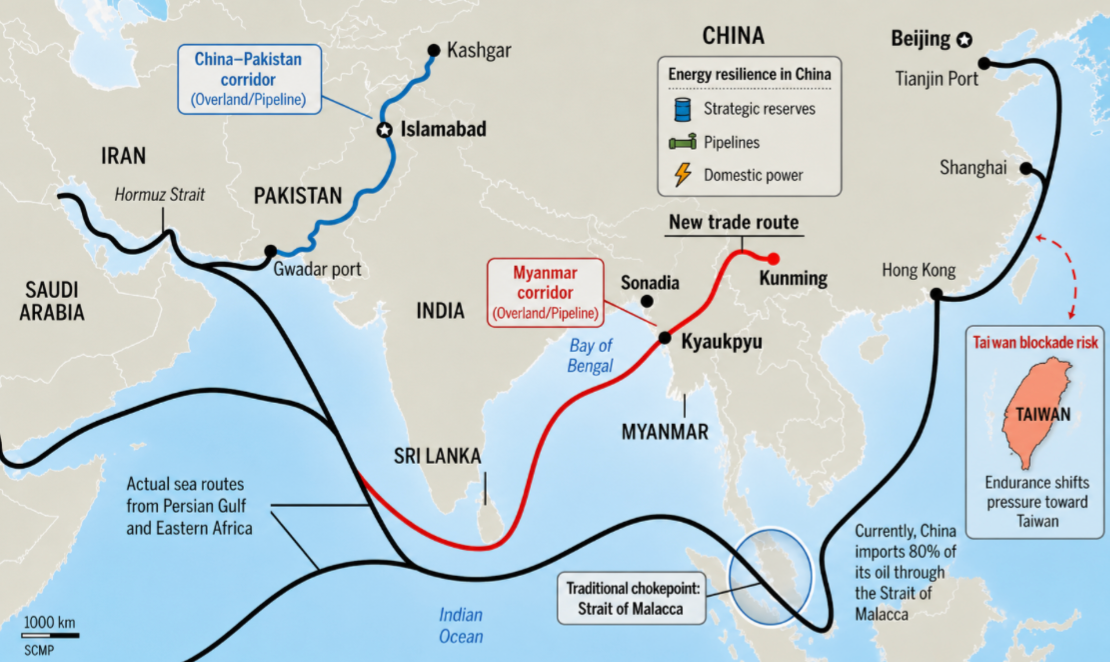
The numbers explain why the assumption appeared to be credible. The U.S. Energy Information Administration's “2026 Chokepoints Update” identified the Strait of Malacca as the principal chokepoint in Asia and Oceania and the largest oil transit chokepoint in the world by volume, with 23.2 million barrels per day of oil flow in the first half of 2025 [11]. In that period, China accounted for 48% of the import volume passing through the strait [12]. These figures form the foundation of China's “Malacca dilemma” and the reason Washington has long treated maritime energy leverage as a strategic asset [13]. The chokepoint framework assumed that time was on America's side as threatening Malacca was perceived as a method to generate fast political pressure on Beijing. However, chokepoint deterrence is weakening because Chinese leaders reached the same conclusion and spent two decades solving it [14].
In 2003, the phrase “Malacca Dilemma” entered Chinese strategic discourse through President Hu Jintao, who reportedly warned senior officials that “certain major powers” were bent on controlling the Strait of Malacca and called for a national strategy to reduce that exposure [15]. In the years that followed, energy security migrated from a state-owned enterprise concern to a part of national security planning. Successive Five-Year Plans elevated supply-route diversification and energy security to central priorities [16]. Strategic petroleum reserve construction began in 2007 and accelerated dramatically through the 2010s [17]. Pipeline projects with Russia, Central Asia, and Myanmar, each of which physically bypasses Malacca, began or expanded on timelines that map closely to warnings that President Hu had articulated [18].
The Malacca constraint has been a factor in Chinese decision-making, consequential enough to drive billions of dollars of investment and two decades of policy effort [19]. One reasonable objection is that energy resilience could serve generic goals such as climate transition or Middle East volatility, rather than Taiwan specifically. However, the timing of Chinese investment clusters around the Malacca chokepoint problem, and infrastructure that has been built specifically to physically bypass U.S. naval reach is demonstrably not energy-transition investment. Chinese investment demonstrates a deliberate agenda to weaken one of the most important external checks on Chinese strategic freedom of action.
Beijing’s energy restructuring is the main variable shifting the timeline of coercive isolation by circumventing the Malacca dilemma. China’s increased energy resilience, combined with Taiwan’s vulnerabilities, has degraded the amount of leverage Washington holds over Beijing through chokepoint strategy.
China’s Energy Endurance Is Lengthening
China's energy system relates to the Taiwan issue because it determines how quickly outside intervention would hurt. The more China can rely on domestic generation, reserves, and alternate routes, the less likely it is that energy deterrence would work. Beijing appears to understand this vulnerability and has worked to reduce the share of its economy exposed to maritime energy coercion, extending its crisis-endurance window from weeks to months.
China's energy base is more diversified than the Malacca framing suggests. On the production side, EIA’s 2023 breakdown shows that China’s primary energy production that year was 73% coal, 7% petroleum, 7% natural gas, 4% nuclear, and 9% renewables. On the consumption side, China got 62% of its energy from coal, 20% from oil, 9% from natural gas, 3% from nuclear, and 6% from renewables in 2023 [20]. Chinese official data for 2024 confirm the trajectory: total energy consumption rose 4.3%, but crude oil consumption fell 1.2%, while electric power consumption rose 6.8%. Coal’s share of total energy consumption fell by 2.1 percentage points to 53.2%, while clean energy rose from about 26.4% to 28.6% [21]. Although China still consumes far more oil than it produces, its energy base is becoming diversified enough that maritime oil disruption alone would not cripple the system immediately.
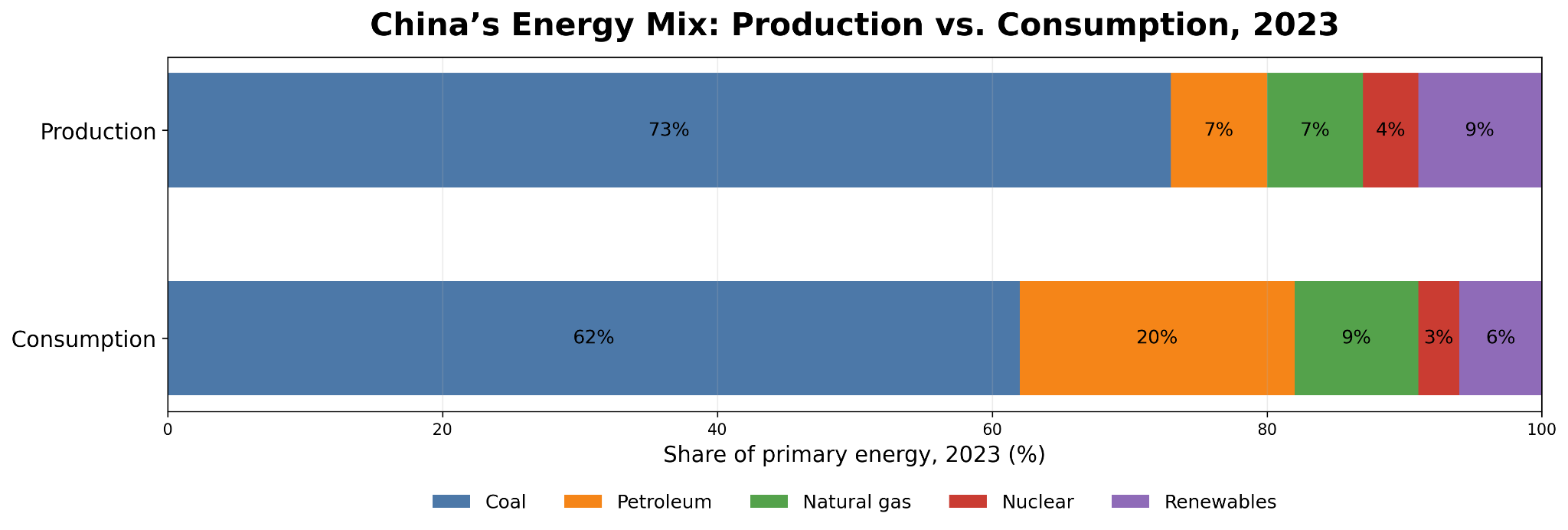
Figure 1. China’s Energy Mix: Production vs. Consumption, 2023. China’s energy system remains coal-dominant on both the production and consumption sides, meaning that maritime oil disruption would not immediately cripple the broader energy system.
The increasing electrification matters because it moves portions of the Chinese economy away from direct dependence on imported oil. According to the International Energy Agency, China’s electricity demand approached 10,000 terawatt-hours in 2024, twice that of the United States, and has averaged 6% growth annually from 2016 to 2025 [22]. Chinese demand for fossil fuels has passed its peak, with fuel use slightly down in 2024 and 2.5% below 2021 levels [23]. In 2024, electric vehicles made up nearly half of new vehicle sales in China [24]. Industry accounts for roughly 60% of China’s electricity consumption, far higher than in most advanced economies [25]. This electrification of the industrial sector reflects how China’s productive capacity is increasingly tied to a domestically generated and managed energy system rather than imported oil. Electrification helps prevent economic shocks from crippling the Chinese economy during a potential crisis [26]. A less oil-intensive China is harder to deter through threats against distant maritime energy routes.
Coal sits behind that electrified industrial base as a strategic safety net. China uses over half of the world’s coal and possesses an estimated 13% of global coal reserves. Beijing has tried to reduce coal’s share of the energy mix because coal is dirty, water-intensive, and logistically constrained [27]. Yet coal also remains available as a crisis fallback, allowing China to maintain industrial output, electricity generation, heating, and basic economic stability even if imported oil becomes more expensive or maritime flows are disrupted. China’s energy strategy is dual-track: coal provides crisis resilience, while renewables, storage, grid infrastructure, electric vehicles, and rail reduce marginal dependence on imported oil [28]. China still uses significant amounts of imported energy for aviation, shipping, petrochemicals, military mobility, and parts of long-distance transport, but to an increasingly lesser extent [29]. The more China can rely on domestic electricity and coal-backed generation, the less immediate leverage Washington gains from threatening maritime oil flows during a Taiwan crisis.
An important measure of how much time Chinese planning has bought is in its substantial strategic and commercial petroleum reserves. The U.S. Energy Information Administration estimated that China’s strategic oil inventories, including government-held and commercial inventories treated as strategic, reached nearly 1.4 billion barrels by December 2025. Government-held inventories alone were closer to 360 million barrels, with roughly 1 billion barrels held commercially [30]. In 2024, China consumed about 16.3 million barrels per day of petroleum while producing about 4.3 million barrels per day domestically [31]. A crude import cutoff would leave a rough import-replacement gap of about 12 million barrels per day. On that basis, government-held stocks alone would cover about 30 days of lost imports, while the broader 1.4-billion-barrel estimate would cover roughly 115 to 120 days. Columbia University’s Center on Global Energy Policy estimated in 2023 that Chinese storage could provide about 80 days of supply in an import disruption [32], and a 2026 operational assessment modeled a 60-to-100-day sustainment window [33]. These reserves push the moment at which pressure becomes politically intolerable from weeks into months [34].
China has also diversified supply routes through trade policy. The Belt and Road Initiative, launched in 2013, made overland energy corridors a deliberate alternative to maritime supply lines, with Chinese analysts presenting projects such as the China-Pakistan Economic Corridor as overland supplements less vulnerable to hostile naval blockades [35]. In 2024, 10% of China's oil imports arrived overland via pipelines from Russia, Kazakhstan, and Myanmar, up from zero before the China-Kazakhstan pipeline opened in 2006 [36]. These pipelines have historically run well below capacity, leaving room to absorb additional flow [37]. These pipelines have helped to provide alternative flows that challenge U.S. naval interdiction strategies [38]. Shipping routes themselves are also more flexible than the Malacca dilemma suggests [39]. The Strait of Malacca is still the most crucial chokepoint, but tankers can reroute through alternative passages such as Sunda or Lombok. These routes are longer, more expensive, and less efficient, and a determined U.S. campaign could try to monitor or block them. But that is precisely the point: interdiction would no longer be a simple Malacca-centered strategy. It would require a wider and more difficult-to-sustain blockade, reducing the likelihood that maritime pressure could generate fast and decisive leverage [40].
Through investment in LNG infrastructure, battery storage, and long-term gas contracts with Russia and Qatar, China has steadily reduced the share of its economic activity that depends on energy flowing through waters the U.S. Navy can dominate [41]. The idea that controlling a single chokepoint can decisively shape China’s behavior is increasingly outdated [42]. China’s coal-backed, increasingly electrified, reserve-supported, and diversified energy system is more capable of enduring a prolonged crisis today than it was five years ago, and will be more capable five years from now. China cannot avoid maritime pressure in the event of a Taiwan crisis. However, Beijing may judge that such pressure would be insufficient to stop coercion against Taiwan quickly.
Taiwan’s Compressed Energy Window
If China has extended its crisis-endurance window by months, Taiwan’s most acute energy vulnerability, LNG-dependent electricity, could destabilize the grid within days. That asymmetry is what makes coercive isolation a viable strategy for Beijing. Energy resilience does not cause Chinese aggression: Beijing’s claim to Taiwan is rooted in nationalism, regime legitimacy, territorial integrity, and strategic geography [43]. Beijing does not need to defeat Taiwan outright; it just needs to create a crisis of confidence faster than Taiwan, the United States, or global markets can restore normal flows of fuel, food, and shipping.
Taiwan has limited domestic resources and a deep dependence on imports. In 2024, Taiwan imported more than 94% of its energy demand [44]. The 2024 power distribution was roughly 43% natural gas, 39% coal, 13% renewables, and 5% nuclear, with the last nuclear plant closing on May 15, 2025 [45]. Taiwan produced only 2.1 billion cubic feet of natural gas, less than 0.5% of its total annual consumption of 1,021 billion cubic feet, and produced zero coal domestically [46]. Petroleum is also entirely import-dependent, with minimal domestic crude production and roughly 60% of 2025 petroleum-product imports consisting of naphtha for the petrochemical and semiconductor supply chains [47]. The dependency by country is concentrated and almost entirely seaborne. In 2025, Taiwan's roughly 22.4 million metric tons of LNG imports are concentrated among a few seaborne suppliers, primarily Qatar (36%), Australia (34%), and the United States (11%) [48]. Following a February 2026 agreement with Washington, Taiwan announced plans to raise the U.S. share to 30% [49]. In 2025, most coal imports came from Australia (49%) and Indonesia (30%). Critical elements of Taiwan’s economy rely on these large, regularly scheduled cargo shipments. Every barrel and every ton of this supply transits the same maritime passages that a coercive isolation campaign would block.
Taiwan’s limited stockpiles compound its seaborne dependence. The Ministry of Economic Affairs estimated in 2026 that the island had only 10 to 11 days of natural gas supply in stock [50]. Taiwan is also dependent on imported coal, which fuels about 39% of Taiwanese generation [51]. Coal stockpiles are also finite: Taiwan legally mandates 30 days of coal reserves, and oil stockpiles estimated at 146 days [52]. Taiwan's LNG reserves only last a week and a half, rendering its grid incredibly vulnerable.
LNG is vulnerable as the linchpin of Taiwan’s electricity supply because the physics of the fuel impose unique constraints. Natural gas must be kept at -162 degrees Celsius to condense into a liquid, reducing its volume by a factor of 600, making transoceanic transport economically feasible [53]. Maintaining that temperature requires heavy specialized cryogenic tanks both on board purpose-built LNG carriers and at destination terminals, where the cargo is held until it can be passed through regasification vaporizers that warm the liquid back into transmission-grade gas [54]. LNG infrastructure is expensive, slow to build, immobile, and stored gas boils off if unused [55]. Strategic stockpiling of LNG at the scale of crude oil is essentially impossible. A country that depends on LNG for nearly half of its electricity is effectively running a just-in-time supply chain for its grid [56].
Taiwan’s physical geography compresses the constraints of LNG further. Every LNG cargo entering Taiwan passes through one of three regasification terminals, all located on the island’s western and northwestern coast. The Yung-An terminal in Kaohsiung, commissioned in 1990, was Taiwan’s primary import facility. Taichung followed in 2009, and Guantang in Taoyuan received its first LNG cargo on April 1, 2025, supplying the Datan power plant [57]. All three facilities face the Strait while handling all of Taiwan's LNG imports that supply the majority of Taiwan’s electricity. Coercion would not require a full encirclement of Taiwan. Beijing could generate serious pressure by disrupting tanker access to the three terminals, delaying cargoes through inspections, declaring exclusion zones near ports, or degrading the terminals’ ability to operate. LNG carriers would not be willing to “run the gauntlet” [58]. A sustained disruption at the terminals would cascade quickly into the power system. The chokepoints that matter most in a coercive isolation campaign are LNG terminals, ports, and import nodes on Taiwan’s own coastline.
A reasonable objection may say that Taiwan’s LNG dependence is more resilient than suggested. The March 2026 Qatar disruption demonstrates this. Even after Iranian strikes damaged Qatari LNG capacity, knocking out roughly 17% of Qatar's LNG export capacity, Taiwan avoided an immediate energy crisis by paying higher prices and drawing more LNG from alternative suppliers [59][60][61]. This example highlights the difference between supplier and terminal disruption. Coercive isolation would target the delivery system: Taiwan’s three regasification terminal [62]. Shipping firms responding to risk premiums would not sail replacement cargoes [63][64]. China's exposure to the same disruption also underscores the asymmetry in a cross-strait crisis. Although Qatar overtook Australia as China's largest LNG supplier in 2025, LNG provides under 10% of China's total energy consumption [65][66]. China can absorb LNG market shocks in a way Taiwan cannot [67]. The Iran-Qatar episode underscores Taiwan’s dependence on constantly available LNG.
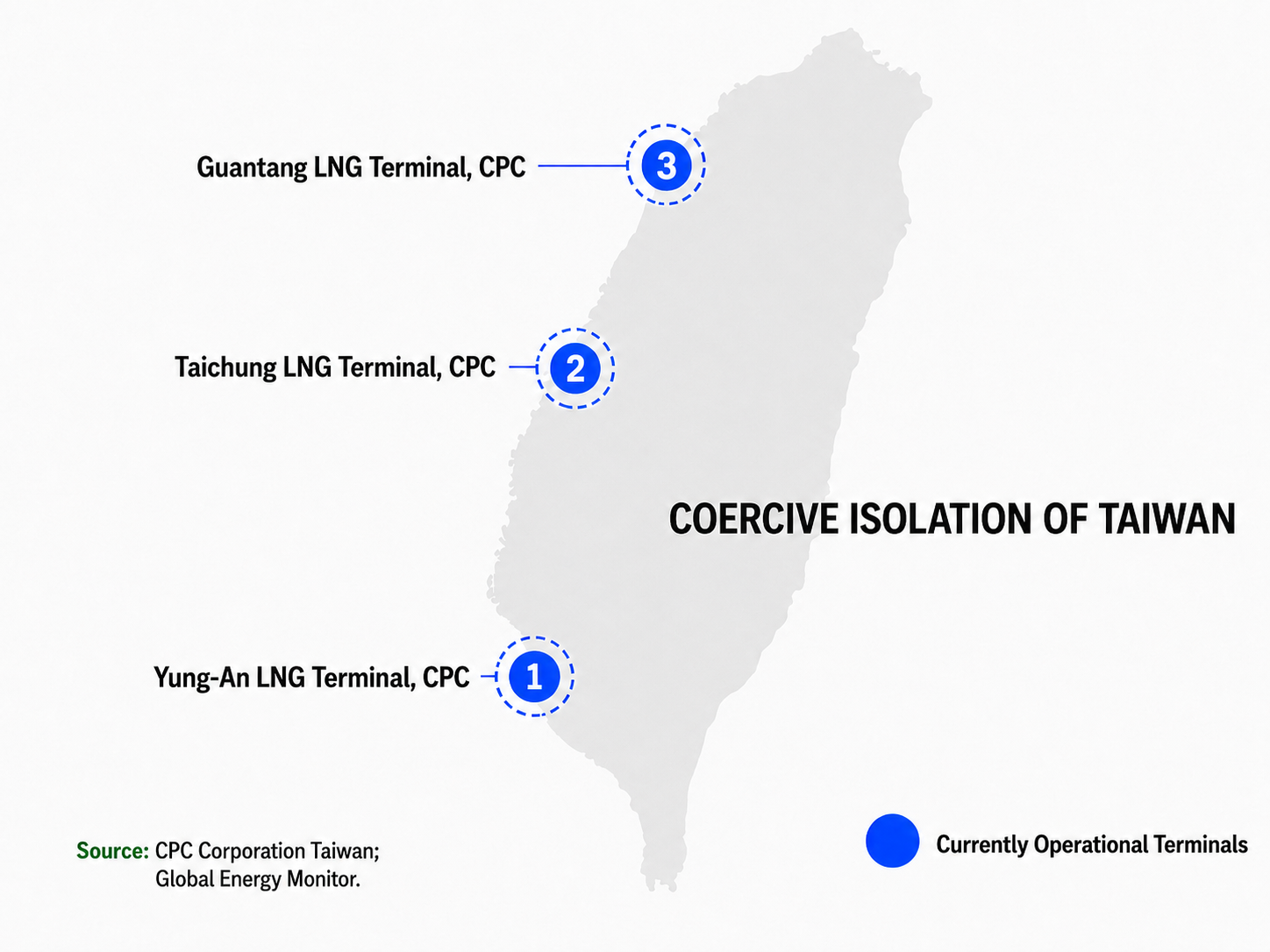
Figure 2. Coercive Isolation of Taiwan’s LNG Terminals. Taiwan’s three operational LNG import terminals, Yung-An, Taichung, and Guantang, are located on the island’s western and northwestern coast facing the Taiwan Strait.
Energy is the most pressing vulnerability, but the same logic extends to food. Taiwan’s domestically grown calories only accounted for 31% of consumption in 2022 [68]. Taiwan's Ministry of Agriculture estimated in 2025 that public grain reserves could sustain the island for roughly 5.5 months [69]. Even so, a blockade would only need to disrupt expectations of regular supply to generate political pressure long before any actual gap in calories appears. As with energy, the coercive mechanism is the erosion of confidence in expected flow of imports.
Shipping is the link between shortages and political pressure. The Center for Strategic and International Studies estimates that Taiwan’s ports handled about $586 billion in trade in 2022, nearly all flowing through a small number of ports close to the Chinese mainland [70]. A Taiwan crisis would lead shipping firms to avoid the area because of risk, insurance costs, and delays. The act of avoidance would signal that fuel, electricity, food, and exports may be at risk [71]. Democracies are beholden to their constituents, and the perception of shortage can induce panic in a consumer economy well before any damage from a physical shortage bites. Public confidence is fragile, which is why coercive isolation is an attractive strategy.
The vulnerabilities described above are precisely what recent Chinese military behavior has been rehearsing. The PLA's Joint Sword 2024A and 2024B exercises involved air, naval, rocket, and coast guard forces around Taiwan. The exercises practiced seizing maritime and air superiority, blockading key ports, and launching precision strikes. Joint Sword 2024B involved 111 People’s Liberation Army (PLA) aircraft crossing the Taiwan Strait centerline and 34 PLA vessels around Taiwan. The exercises were the first time Chinese Coast Guard ships encircled Taiwan, demonstrating growing integration between China's military and maritime law enforcement forces [72]. These exercises suggest that many of the tools needed to isolate Taiwan are increasingly operationally available. More worryingly, they show Beijing rehearsing the kind of ambiguous, gradual pressure that would exploit the timeline gap.
Taiwan is dangerously exposed because its most important energy system depends on continuous maritime access to a small number of exposed terminals. Beijing would only need to make tanker access uncertain to put immediate pressure on Taiwan. This is compounded by Chinese exercises practicing the maneuvers needed to coercively isolate Taiwan.
Why the United States Is Effectively Absent from the Decisive Phase
American policy levers should be evaluated on whether they can operate inside the first days of coercive isolation, or the “decisive phase,” when Taiwan's energy, shipping, and confidence shocks would be most acute. Coercive isolation would be designed to produce political effects in days or weeks, while U.S. responses would be too slow. The main American tools: tripwire deterrence, emergency LNG resupply, convoy escort and sanctions, struggle to operate on the timeline Taiwan requires.
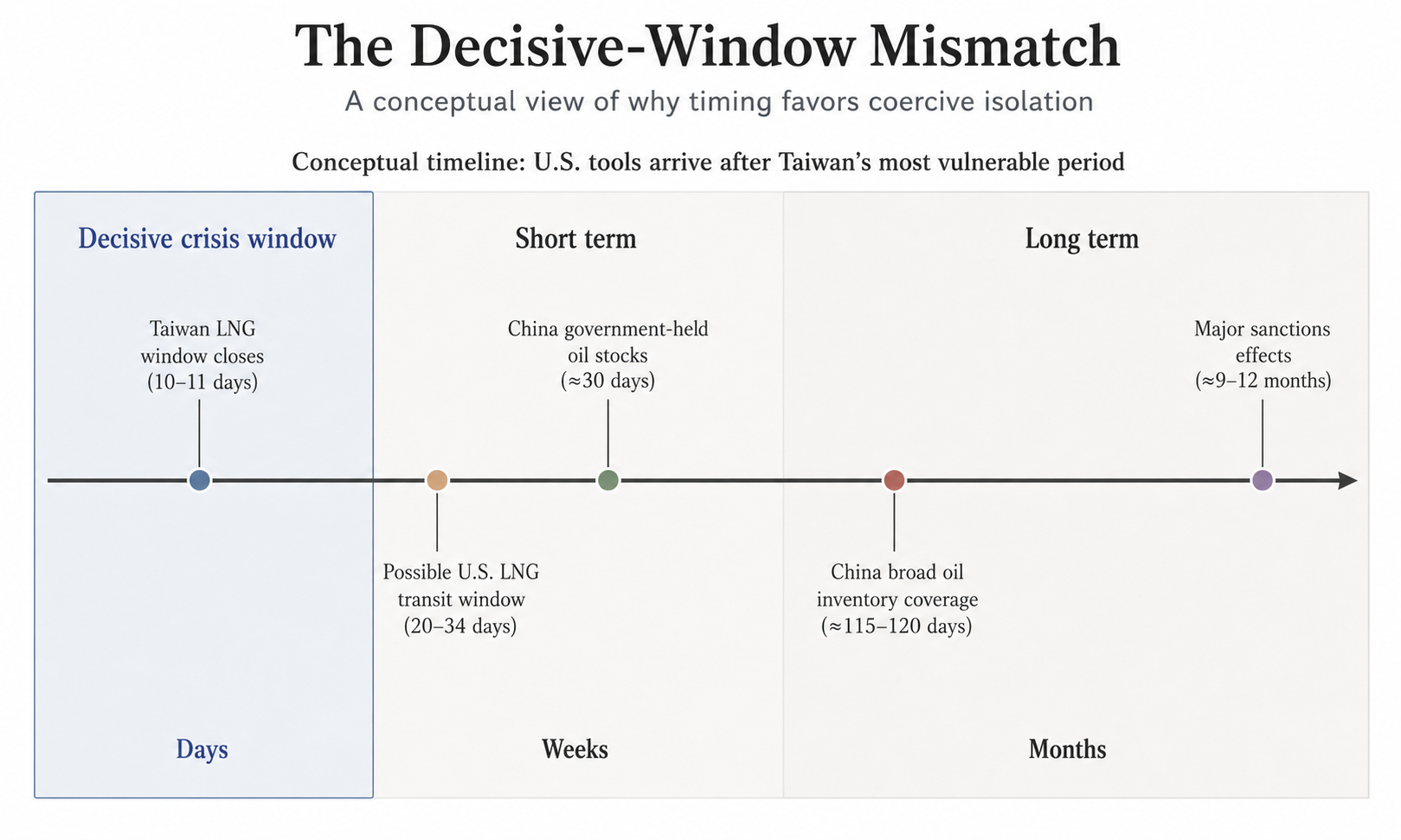
Figure 3. The Decisive-Window Mismatch. Taiwan’s LNG vulnerability operates on a roughly 10-to-11-day timeline, while U.S. Gulf Coast LNG resupply, Chinese reserve exhaustion, and sanctions effects unfold over much longer periods.
Tripwire deterrence, the practice of stationing a small forward-deployed force in an ally’s territory so that any attack would kill Americans and automatically commit Washington to retaliation, assumes a clear moment of decision that coercive isolation specifically avoids [73]. Coercive isolation’s use of coast guard inspections and customs enforcements creates gradual pressure that can be framed as law enforcement blurring the line between coercion and war, denying Washington a clean trigger [74][75]. Taiwan also does not host a U.S. tripwire force, and small deployments no longer function as warning wires against Chinese precision-strike and maritime capabilities; instead, they create a liability which must be supplied.
American strategic ambiguity compounds doubts surrounding intervention. Only 13% of surveyed U.S. experts and 9% of Taiwan experts are completely confident Washington would intervene militarily against a blockade [76]. That uncertainty is itself a permissive condition for Beijing.
Emergency LNG resupply is the one American tool that could plausibly operate inside Taiwan's decisive window [77]. However, it would also be the hardest to actually deliver. The closest large-scale U.S. LNG export capacity sits on the Gulf Coast. Transit from those terminals to East Asia runs 20-34 days, and U.S. LNG export capacity is contractually committed years in advance to existing buyers [78]. The cargoes that could most plausibly reach Taiwan within ten days are those already at sea, vessels mid-voyage that could be diverted by their cargo owners. Diversion clauses are standard in LNG sale and purchase agreements, and traders divert cargoes within days when prices move [79]. But the economic and political mechanics of actually making it happen are very difficult. Diverting LNG shipments at scale would require either a coordinated U.S. government program to indemnify cargo owners or a price differential so large that Taiwan becomes the natural commercial destination [80]. The first takes time to set up; the second presumes a functioning spot market that Beijing's exclusion zones may have already disrupted.
Redirected LNG carriers would still need to reach Taiwan's three regasification terminals, all on the Strait-facing coast within easy reach of Chinese interdiction. LNG carriers are civilian vessels, extraordinarily expensive, and acutely insurance-sensitive; war-risk premiums alone can render voyages unfeasible, so an exclusion zone near a terminal does not need to sink a tanker to deter one [81]. Beijing would only need to make the approaches sufficiently risky that owners and insurers would refuse the voyage [82]. Convoy escort by U.S. naval forces is theoretically available, and is the most concrete form of the pre-positioned military signaling sometimes proposed as a short-timeline deterrent [83]. Less escalatory variants, such as public posture statements, operate on similar timelines but rely on Beijing reading them as credible, which decades of strategic ambiguity have specifically taught Beijing not to assume [84]. Convoy escort itself is exactly the kind of unambiguous American military commitment that strategic ambiguity has spent decades avoiding, and that the gradual nature of coercive isolation is meant to forestall [85]. The choice Washington would face is whether it is willing to escalate visibly to make it work, on a timeline of days, with Taiwanese grid collapse as the cost of hesitation.
Even under best-case conditions, sanctions operate on a timeline of months. The 2022 Russia sanctions, arguably the fastest coordinated economic pressure campaign in modern history, took roughly a year to bite. The most consequential measure, the G7 oil price cap, a sanctions mechanism that prohibits companies in coalition countries from providing maritime services, took nine months to implement, and meaningful revenue effects did not appear until the first half of 2023 [86]. Even with exceptional political alignment and a target economy one-tenth the size of China's, the effects were sluggish.
A sanctions campaign against China would have to reckon with the costs of imposing it. China is the world's largest trader and its second-largest economy, and is deeply embedded in the supply chains that any sanctioning coalition depends on. The Atlantic Council estimated that a maximalist sanctions package targeting major Chinese financial institutions would put at least $3 trillion in trade and financial flows at immediate risk [87]. For G7 and EU economies, which absorb roughly 40% of Chinese exports, the inverse exposure is also acute [88]. China controls roughly 70% of global rare earth mining, 90% of separation and processing, and 93% of magnet manufacturing [89]. Beginning in April 2025, the country imposed escalating export controls with extraterritorial licensing reaching foreign firms that use Chinese-processed materials [90]. Any government considering serious sanctions must face the immediate prospect of losing access to materials that their defense industrial base and clean energy transition depend on.
Below the threshold of unambiguous invasion, the alignment that made the Russia coalition possible would not exist; allies would face the same trade exposures without the similar levels of provocation, and the ambiguity of the campaign would make the scale of response heavily contested. Sanctions would not arrive in time to alter the outcome of a campaign designed to resolve in weeks, and the most credible threats, measures large enough to actually constrain Beijing, would be exactly the measures most governments cannot politically commit to in advance.
Conclusion: From Chokepoints to Taiwan Crisis Endurance
Since American tools cannot operate inside Taiwan’s decisive window, deterrence must hinge on denying Beijing a quick coercive result. The issue is finding pressure that would hurt China quickly enough to stop a Taiwan campaign. A vulnerability that bites China after three months may not deter a strategy created to succeed in three weeks.
The chokepoint framework assumed that American pressure on China’s imported energy could make a Taiwan crisis unthinkably costly. But China’s internal energy balancing has rapidly stretched the time between maritime disruption and domestic crisis. Taiwan’s current LNG dependence has an opposite effect, as their resilience is a short window in which their electricity supply and political stability could be coerced. By outlasting Taiwan’s fragile systems, coercion becomes a viable strategy for China.
Coercive isolation would still be far from easy for China. Chinese leaders may overestimate their own energy resilience. Authoritarian systems are prone to information distortion, and a leadership facing domestic nationalist pressure may act on inflated confidence rather than sober analysis [91]. An overconfident Beijing might initiate coercion it cannot sustain, creating opportunities for the United States and Taiwan; it might also miscalculate the American response, turning a controlled pressure campaign into uncontrolled escalation [92]. The deterrence problem comes down to how to ensure that accurate signals reach a system that may be structurally resistant to receiving them.
Taiwan’s resilience is its strongest form of deterrence. Larger LNG inventories, hardened regasification terminals, diversified fuel storage, distributed generation, backup power for critical industries, and port continuity planning would all lengthen the time required for coercive isolation to produce political effects. Their goal is to stretch the window of endurance, giving the US and allies time to mobilize. If Taiwan can maintain public confidence through the first weeks of a crisis, Beijing loses the quick-result appeal of coercive isolation.
Beyond the Taiwan issue, a successful coercion campaign would establish that pressure below the invasion threshold can deliver major political objectives faster than outside powers can respond [93]. Allies already watching Chinese pressure against the Philippines at Second Thomas Shoal would draw the obvious conclusion: U.S. security guarantees operate on timelines that gray-zone coercion can outrun [94]. Regional expectations would shift regardless of subsequent American action [95].
The Malacca framework assumed China could be punished quickly. That assumption becomes outdated with every year that passes. If China expects coercive isolation to work in weeks, repercussions in months may not matter since a Taiwan crisis would already be over. The crisis is therefore becoming a contest of endurance only between China and Taiwan. Deterrence cannot rely on the assumption that one maritime chokepoint will do the work of strategy.
Notes
[1] Lyle J. Morris et al., Gaining Competitive Advantage in the Gray Zone: Response Options for Coercive Aggression Below the Threshold of Major War (Santa Monica, CA: RAND Corporation, 2019).
[2] U.S. Energy Information Administration, "China, the United States, and Japan Hold Most Strategic Oil Inventories in 2025," Today in Energy, April 20, 2026.
[3] U.S. Energy Information Administration, Taiwan Analysis Brief (Washington, DC: U.S. Energy Information Administration, April 2026), 1, 6.
[4] Julia Famularo, Great Inspectations: PRC Maritime Law Enforcement Operations in the Taiwan Strait, China Maritime Report no. 48 (Newport, RI: China Maritime Studies Institute, U.S. Naval War College, July 2025).
[5] Gabriel B. Collins, "A Maritime Oil Blockade against China: Tactically Tempting but Strategically Flawed," Naval War College Review 71, no. 2 (Spring 2018): 49–52.
[6] Andrew S. Erickson and Gabriel B. Collins, "China's Oil Security Pipe Dream: The Reality, and Strategic Consequences, of Seaborne Imports," Naval War College Review 63, no. 2 (Spring 2010): 88.
[7] Gabriel B. Collins, "A Maritime Oil Blockade against China: Tactically Tempting but Strategically Flawed," Naval War College Review 71, no. 2 (Spring 2018): 49.
[8] Rockford Weitz, "Strategic Maritime Chokepoints: Global Shipping and Port Perspectives," in Eurasia's Maritime Rise and Global Security, ed. Geoffrey Gresh (Cham, Switzerland: Palgrave Macmillan, 2018).
[9] The White House, Indo-Pacific Strategy of the United States (Washington, DC: The White House, February 2022), 9, 13.
[10] Marc Lanteigne, "China's Maritime Security and the 'Malacca Dilemma,'" Asian Security 4, no. 2 (2008): 143.
[11] U.S. Energy Information Administration, "World Oil Transit Chokepoints," August 5, 2025.
[12] U.S. Energy Information Administration, China Country Analysis Brief (Washington, DC: U.S. Energy Information Administration, May 2025), 18.
[13] Collins, "Maritime Oil Blockade against China," 52.
[14] Ian Storey, "China's 'Malacca Dilemma,'" China Brief 6, no. 8 (April 12, 2006); Bruce Jones, David Steven, and Emily O'Brien, "MAP: China's Energy Vulnerabilities," Brookings Institution, February 26, 2014.
[15] Ian Storey, "China's 'Malacca Dilemma,'" China Brief 6, no. 8 (April 12, 2006).
[16] National Energy Administration of China, 13th Five-Year Plan for Energy Development, trans. China Energy Portal, December 26, 2016; People's Republic of China, Outline of the 14th Five-Year Plan for National Economic and Social Development and Long-Range Objectives for 2035, trans. Center for Security and Emerging Technology, Georgetown University, 2021.
[17] Nan Xie et al., "China's Optimal Stockpiling Policies in the Context of New Oil Price Trend," Energy Policy 105 (June 2017): 332.
[18] U.S. Energy Information Administration, "The Strait of Malacca, a Key Oil Trade Chokepoint, Links the Indian and Pacific Oceans," August 11, 2017.
[19] Christoph Nedopil, "China Belt and Road Initiative (BRI) Investment Report 2024," Green Finance & Development Center, February 27, 2025.
[20] EIA, China Country Analysis Brief, 18.
[21] National Bureau of Statistics of China, "Statistical Communiqué of the People's Republic of China on the 2024 National Economic and Social Development," February 28, 2025.
[22] International Energy Agency, "Demand," in Electricity 2025: Analysis and Forecast to 2027 (Paris: IEA, 2025).
[23] Ciarán Healy, Rebecca McKimm, and Ivo Walinga, "Oil Demand for Fuels in China Has Reached a Plateau," International Energy Agency, March 11, 2025.
[24] Siyuan Gao, "China's Booming NEV Market," Infineum Insight, August 26, 2025.
[25] IEA, "Demand."
[26] Xiaoqing Pan, Baosheng Zhang, and Yiwen Li, "Analysis of China's Oil and Gas Consumption under Different Scenarios toward 2050," Energy 205 (August 15, 2020): 118002.
[27] Brian Hart et al., "How Robust Is China's Energy Security?," ChinaPower, Center for Strategic and International Studies, June 4, 2025.
[28] Erica Downs, "China's Oil Demand, Imports and Supply Security," testimony before the U.S.-China Economic and Security Review Commission, April 24, 2025.
[29] EIA, China Country Analysis Brief, 13, 18; Healy, McKimm, and Walinga, "Oil Demand for Fuels in China."
[30] U.S. Energy Information Administration, "China, the United States, and Japan Hold Most Strategic Oil Inventories in 2025," Today in Energy, April 20, 2026.
[31] U.S. Energy Information Administration, "China's Crude Oil Imports Decreased from a Record as Refinery Activity Slowed," Today in Energy, February 11, 2025.
[32] Paul M. Dabbar, "Potential Energy Challenges from a China-Taiwan Conflict Scenario," Center on Global Energy Policy, Columbia University School of International and Public Affairs, January 25, 2023.
[33] Heritage Foundation, TIDALWAVE: Modeling a U.S.-China Conflict in the Indo-Pacific (Washington, DC: Heritage Foundation, January 20, 2026), Appendix A and Appendix F.
[34] Dabbar, "Potential Energy Challenges."
[35] Andrew Small, The China–Pakistan Axis: Asia's New Geopolitics (London: Hurst, 2015); Hong Yu, "Motivation Behind China's 'One Belt, One Road' Initiatives and Establishment of the Asian Infrastructure Investment Bank," Journal of Contemporary China 26, no. 105 (2017): 353–68.
[36] S&P Global Commodity Insights, "Russia Crude Oil Pipeline Capabilities to Mainland China: The ESPO Crude Oil Pipeline," 2024.
[37] Downs, "China's Oil Demand."
[38] EIA, China Country Analysis Brief, 13, 18; Joseph Webster, Reid I'Anson, and Kevin Li, "What a Middle East Oil and LNG Crisis Means for China and East Asia," Atlantic Council, March 5, 2026.
[39] Jack Herndon, "A Limited Lifeline: Russia's Role in China's Energy Security," Center for European Policy Analysis, September 9, 2025.
[40] Mohd Hazmi bin Mohd Rusli, "Maritime Highways of Southeast Asia: Alternative Straits?," RSIS Commentary no. 24, S. Rajaratnam School of International Studies, Nanyang Technological University, February 10, 2012; ChinaPower Project, "How Much Trade Transits the South China Sea?," Center for Strategic and International Studies, August 2, 2017, updated January 25, 2021.
[41] Erica Downs, Akos Losz, and Anne-Sophie Corbeau, "Unpacking the Recent China-Qatar LNG Deals," Center on Global Energy Policy, Columbia University School of International and Public Affairs, July 18, 2023.
[42] Collins, "Maritime Oil Blockade against China," 49.
[43] Dean P. Chen, "'One China' and the Cross-Taiwan Strait Commitment Problem," China Quarterly 252 (December 2022): 1083–1102.
[44] U.S. Energy Information Administration, Taiwan Analysis Brief (Washington, DC: U.S. Energy Information Administration, April 2026), 1.
[45] EIA, Taiwan Analysis Brief, 6.
[46] EIA, Taiwan Analysis Brief, 7.
[47] Luke Wickenden et al., Dangerous Dependence: Taiwan Becomes World's Largest Importer of Russian Naphtha as Coal Imports Persist (Helsinki: Centre for Research on Energy and Clean Air; Environmental Rights Foundation; Ecodefense; and Urgewald, October 1, 2025), 4, 17, 27.
[48] U.S. Energy Information Administration, "Taiwan," International Analysis Brief, April 3, 2026.
[49] Energy Administration, Ministry of Economic Affairs, Republic of China (Taiwan), "Energy Transition Policy Direction Remains Unchanged with Diversified Deployment and Steady Promotion," November 20, 2025.
[50] EIA, Taiwan Analysis Brief, 6.
[51] EIA, Taiwan Analysis Brief, 9.
[52] EIA, Taiwan Analysis Brief, 7.
[53] U.S. Energy Information Administration, "Liquefied Natural Gas Explained," Energy Explained, last updated June 21, 2024.
[54] U.S. Department of Energy, "Liquefied Natural Gas (LNG)," Hydrocarbons and Geothermal Energy Office.
[55] Eric Yep and S&P Global Commodity Insights Staff, "Taiwan Vulnerable to LNG Supply Risks in the Event of a Maritime Blockade," S&P Global Commodity Insights, May 30, 2024.
[56] Gavin Maguire, "Taiwan Bucks Asia's Clean Power Drive with Record Gas Burn," Reuters, October 31, 2025.
[57] EIA, "Taiwan," International Analysis Brief.
[58] Eyck Freymann, "How Hormuz Could Shape China's Taiwan Strategy," Time, April 16, 2026, https://time.com/article/2026/04/16/hormuz-iran-china-taiwan-strategy/.
[59] Maha El Dahan, Andrew Mills, and Yousef Saba, "Iran Attacks Wipe Out 17% of Qatar's LNG Capacity for up to Five Years, QatarEnergy CEO Says," Reuters, March 19, 2026.
[60] Executive Yuan, Republic of China (Taiwan), "Government Moves to Stabilize Energy Supply, Financial Markets, Consumer Prices amid Middle East Developments," March 12, 2026.
[61] El Dahan, Mills, and Saba, "Iran Attacks Wipe Out 17% of Qatar's LNG Capacity."
[62] Yep and S&P Global Commodity Insights Staff, "Taiwan Vulnerable to LNG Supply Risks."
[63] Mark F. Cancian, Matthew F. Cancian, and Eric Heginbotham, Lights Out? Wargaming a Chinese Blockade of Taiwan (Washington, DC: Center for Strategic and International Studies, July 31, 2025).
[64] Yep and S&P Global Commodity Insights Staff, "Taiwan Vulnerable to LNG Supply Risks."
[65] Zhibo Xiao, "Analysis: China's LNG Imports Fell 12% in 2025 Despite Remaining World's Top Buyer," ICIS, December 30, 2025.
[66] EIA, China Country Analysis Brief, 1, 18–19.
[67] Clyde Russell, "China's LNG Imports Plunge, Helping Asia Adjust to Iran War Losses," Reuters, April 23, 2026.
[68] U.S. Department of Agriculture, Foreign Agricultural Service, "Taiwan Food Security Situation Overview," June 19, 2024, 2.
[69] William Yang, "Taiwan Unveils Plans to Cope with Potential Chinese Military Blockade," Voice of America, October 23, 2024.
[70] Matthew P. Funaiole et al., "Crossroads of Commerce: How the Taiwan Strait Propels the Global Economy," ChinaPower, Center for Strategic and International Studies, August 22, 2024.
[71] Funaiole et al., "Crossroads of Commerce."
[72] U.S. Department of Defense, Annual Report to Congress: Military and Security Developments Involving the People's Republic of China 2025 (Washington, DC: Department of Defense, 2025), 43, 51, 75.
[73] Thomas C. Schelling, Arms and Influence (New Haven, CT: Yale University Press, 1966), 47.
[74] Famularo, Great Inspectations.
[75] Paul Musgrave and Steven Ward, "The Tripwire Effect: Experimental Evidence Regarding U.S. Public Opinion," Foreign Policy Analysis 19, no. 4 (October 2023).
[76] Bonny Lin et al., "Surveying the Experts: U.S. and Taiwan Views on China's Approach to Taiwan in 2024 and Beyond," ChinaPower, Center for Strategic and International Studies, January 22, 2024.
[77] Mark F. Cancian and Eric Heginbotham, The Lights Are On but No One's Home: Wargaming a Chinese Blockade of Taiwan (Washington, DC: Center for Strategic and International Studies, 2025).
[78] U.S. Energy Information Administration, "Expanded Panama Canal Reduces Travel Time for Shipments of U.S. LNG to Asian Markets," Today in Energy, June 30, 2016; U.S. Department of Energy, Energy, Economic, and Environmental Assessment of U.S. LNG Exports: Summary Report (Washington, DC: U.S. Department of Energy, December 2024), S-33.
[79] Steven P. Finizio, "Destination Restrictions and Diversion Provisions in LNG Sale and Purchase Agreements," in The Guide to Energy Arbitrations, 3rd ed. (London: Law Business Research, 2019), 226–27.
[80] Cancian and Heginbotham, Lights Are On but No One's Home, 69; Emily Chow, "More LNG Tankers Divert as Asian Buyers Seek Cargoes," Reuters, March 6, 2026.
[81] Emily Chow, "LNG Tanker Orders Gain Pace Despite Mixed Outlook from Iran War," Reuters, April 27, 2026; John Ollett, "Explainer: War Risk Insurance and AWRP," Argus Media, March 3, 2026; "Maritime Insurance Premiums Surge as Iran Conflict Widens," Reuters, March 6, 2026.
[82] Ahmet Arkan et al., Maritime Protection of Taiwan's Energy Vulnerability (Washington, DC: Foundation for Defense of Democracies, November 17, 2025); Ollett, "War Risk Insurance and AWRP."
[83] Arkan et al., Maritime Protection of Taiwan's Energy Vulnerability; Craig Singleton, Mark Montgomery, and Benjamin Jensen, Chinese Coercion of Taiwan's Energy Lifelines: A Contest Taiwan and the West Can't Afford to Lose (Washington, DC: Foundation for Defense of Democracies, November 17, 2025), 15.
[84] "Strategic Ambiguity toward Taiwan," CFR Education, Council on Foreign Relations, June 8, 2022.
[85] Bradley Martin et al., Implications of a Coercive Quarantine of Taiwan by the People's Republic of China (Santa Monica, CA: RAND Corporation, 2022), 13.
[86] Ben Hilgenstock et al., "The Oil Price Cap and Embargo on Russia Work Imperfectly, and Defects Must Be Fixed," Peterson Institute for International Economics, July 13, 2023.
[87] Charlie Vest, Agatha Kratz, and Reva Goujon, Sanctioning China in a Taiwan Crisis: Scenarios and Risks (Washington, DC: Atlantic Council GeoEconomics Center and Rhodium Group, April 2024).
[88] Agathe Demarais, "Hard, Fast, and Where It Hurts: Lessons from Ukraine-Related Sanctions for a Taiwan Conflict Scenario," European Council on Foreign Relations, July 9, 2025.
[89] Gracelin Baskaran and Meredith Schwartz, "China's New Rare Earth and Magnet Restrictions Threaten U.S. Defense Supply Chains," Center for Strategic and International Studies, October 14, 2025.
[90] International Energy Agency, "With New Export Controls on Critical Minerals, Supply Concentration Risks Become Reality," October 2025.
[91] Ronald Wintrobe, The Political Economy of Dictatorship (Cambridge: Cambridge University Press, 1998), 25.
[92] Jennifer Welch et al., "Xi, Biden and the $10 Trillion Cost of War Over Taiwan," Bloomberg, January 9, 2024.
[93] Susan M. Gordon and Michael G. Mullen, co-chairs, and David Sacks, project director, U.S.-Taiwan Relations in a New Era: Responding to a More Assertive China, Task Force Report no. 81 (New York: Council on Foreign Relations, June 2023).
[94] Asia Maritime Transparency Initiative, "Shifting Tactics at Second Thomas Shoal," Center for Strategic and International Studies, August 22, 2024.
[95] Bonnie S. Glaser and Jennifer Lan, "Taiwan's Growing Distrust of the United States," German Marshall Fund of the United States, August 18, 2025.